Leading culture

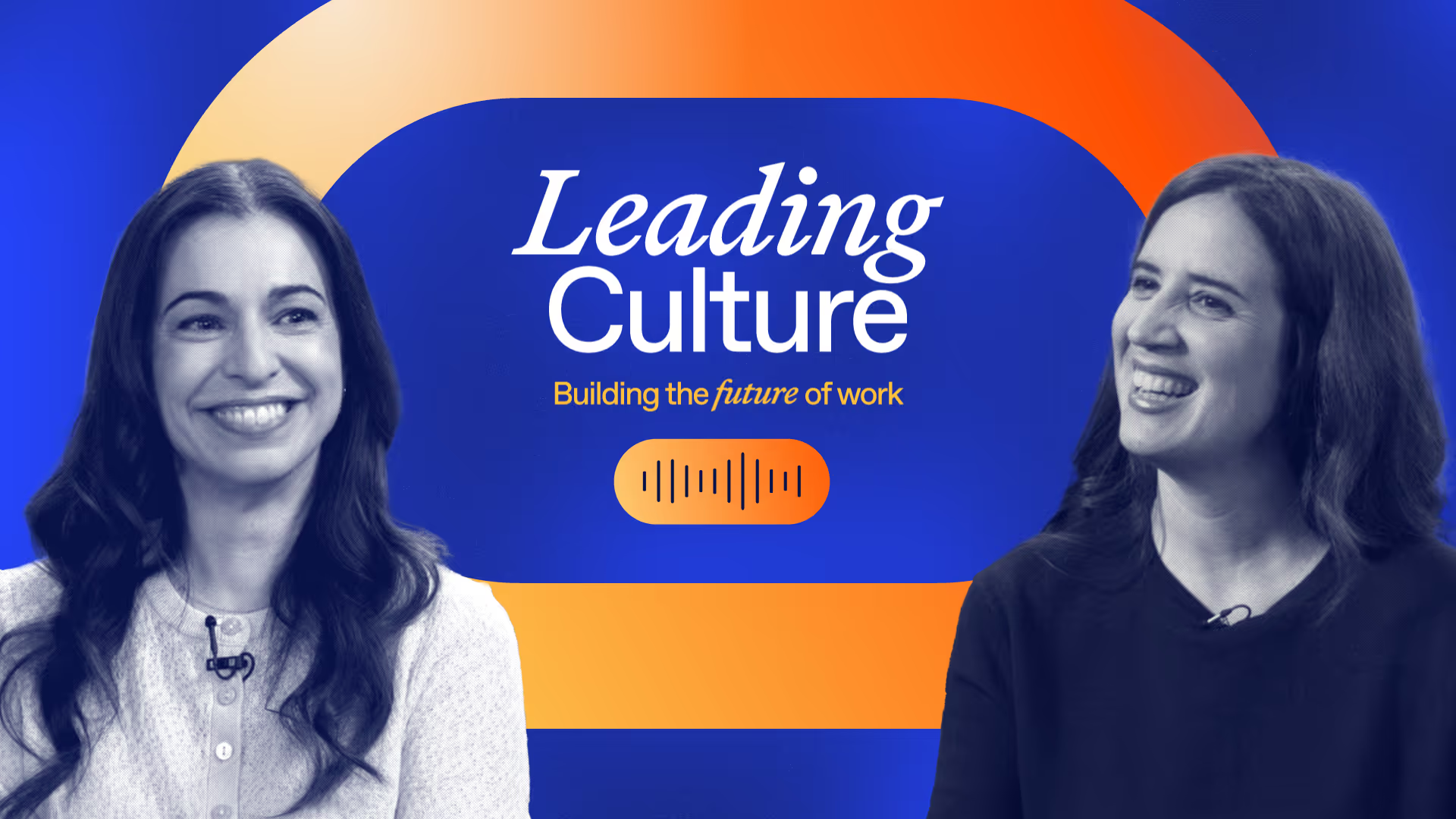
Meaning at Work vs Meaning in Work (Mike Ross, former CHRO at Simons, and Kahina Ouerdane, CPO at Workleap)

What does it really mean to find meaning at work? And who’s responsible for it — you, your boss, or does it fall somewhere in between?

In this episode, Kahina Ouerdane, Chief People Officer at Workleap, sits down with Mike Ross — former CHRO at Simons, partner at Juniper, and PhD researcher on the psychology of work — for a conversation about what truly makes work matter. From purpose-driven Gen Z to the misunderstood power of rituals, Mike and Kahina breaks down the difference between meaning in work vs. meaning at work, why culture is more than a buzzword, and how leaders can stop systematizing empathy and start showing up like actual humans. It’s an invitation to listen, reflect, and tap into the power of collective intelligence — because meaning at work isn’t something we find alone.

Subscribe to the podcast

In the Leading HR Experiments podcast, HR and people leaders share the bold bets they’re making on their teams: what they tried, what worked (or didn’t), and what they learned along the way.

Kahina Ouerdane is the Chief People Officer at Workleap and the host of the Leading Culture podcast. Mike Ross is a PhD researcher studying meaning in work at Concordia University, former CHRO at Simons and current board member.

Episode transcipt

Mike – 00:00
The statistic right now, globally—I think the most recent one—is that over two thirds of employees are either disengaged or actively disengaged. We spend about half of our waking hours during our working years working. And I remember thinking to myself, that is a really interesting problem to try and help solve.

Kahina – 00:21
Welcome to Leading: Building the Future of Work. I'm Kahina Ouerdane, Chief People Officer at Workleap. I've always truly believed in the power of collective intelligence—how people coming together can really create a whole bigger than the sum of its parts.

And actually, that's exactly what this podcast is about. We're having real conversations about what it takes to lead in today's workplaces—how to navigate change, to build strong cultures, and just to evolve the ways we work.

Today, I'm joined by Mike Ross, a member of the board and former CHRO of Simons, a leading North American retailer with 5,000 employees. Mike is currently doing a PhD at Concordia University, and he's a partner at Juniper, a consulting firm specializing in strategy, culture, and innovation. Prior to Simons, he was a consultant at McKinsey & Co., focused on transforming Fortune 100 companies into better workplaces.

Kahina – 01:14
Mike has recently published, with two co-authors, a book: The Surprising Psychology of High Performers. Hi, Mike.

Mike – 01:22
Hey, Kahina.

Kahina – 01:23
Very happy to have you here with us today.

Mike – 01:25
Thanks for inviting me. It's such a pleasure.

Kahina – 01:27
Thank you. Yeah. There are so many things we could be talking about together. I will dive into a very light one: the meaning.

Mike – 01:33
The meaning.

Kahina – 01:34
Let's start with the shallow stuff.

One of the things that we've observed a lot in the past years—and I'm sure you can attest to that as well in your former role—is that the new generation coming into the workplace, Gen Z as we call them, have been talking a lot about finding their purpose and making sure that their work is aligned with their purpose and the work that they do, and asking that of employers to some extent.

And then at the same time, I'm also thinking, well, you know, finding a sense of purpose is also something very personal, very intimate, that maybe should be starting from within. So I'm really curious to hear your thoughts on this, both as a leader and also as a researcher.

Mike – 02:10
Yeah. Well, I mean, it is the question, I think, that I'm really interested in these days, and it's the one that I'm spending all my time thinking about. Right?

As you said, I've left my full-time role at Simons to come do a PhD here in Montreal at Concordia University. My PhD is really focused on this notion of meaning in work.

And I think perhaps what I would do is I would start with a little bit of an idea of, let’s talk about vocabulary a little bit, right? Because when people talk about meaningful work, they talk about meaning of work, meaning in work, and meaning at work. And so, if it's okay, I'll get a bit wonky, and I'll try and split those three apart.

So meaning of work is this idea of: what is work, right?

Mike – 02:50
What does it mean for us as humans to labor, to do things, to exchange our efforts for sometimes pay, or also for other benefits, right? So that's not really the focus that I'm interested in. I don't think that's necessarily relevant to our conversation, because this is a broader societal question.

But meaning in work and meaning at work are…

Meaning in work is this idea of: what is it that I do, and how do I get a sense of meaning from what I do? So I'm a doctor, I'm a nurse, I'm a guy who works in a factory assembling something. That is this notion of: I have this job, and I get meaning from that.

Separate to that is this notion of meaning at work.

Mike – 03:30
And meaning at work is often tied to the place that I work and the environment in which I work. And I think it's really interesting to try and… I'm being a bit disciplined about this, because I think often we conflate the two and we think, “Oh, I've got to fix this,” or, “As a CHRO or as a CPO, I've got to make sure that my people have this sense of meaning in both things.”

And I think you can impact that—but I think we’ve got to be careful to split them apart.

Kahina – 03:53
It's so interesting. And so meaning in work, meaning at work is very much linked to, I think, something I've experienced in my tenure and my role, which is around: what can the employer provide and to what extent, as opposed to what is something that I should be looking for?

Maybe just an anecdote—that’s something that we've lived. A few years back, I was talking a lot about that at work, and we were talking about, you know, finding your spot, and finding that place where everything is aligned, and so on. And I started talking about this a lot to employees, and then some people would come and say, “Okay, so when are you finding me myself?”

Mike – 04:25
“Give it to me, give it to me.”

Kahina – 04:26
You know? And then we kind of needed to rebalance a little bit the responsibility there between the employees and the employers when it came to that—to the extent that we were even, like, paraphrasing JFK, saying, “Well, don't ask what the company can do for you. Also ask what you can find within yourself that will eventually benefit the company.”

So maybe that's a good explanation of what I was experiencing in the field of meaning in work and meaning at work.

Mike – 04:49
Yeah, yeah. And I think that it's—as with all things, right—it’s not binary. It's not black and white, in the sense that, you know, as an employer, let's say I give you a task and your job is to assemble pens, right?

And your job is just to put the little tip—you know, you screw the little tip on the pen, that's all that you do. And you say, “Hey, I'd like to learn something else,” and I say, “No, you're not allowed to learn anything else. Just do the thing I told you to and do it exactly the way I tell you.”

Well, I would say that as an employer, you're limiting my scope of ability to find meaning in my work.

At the same time, you may say, “Hey, this is your company. I put you in place as the CEO, you can do whatever you want with it, all this kind of thing. If you can't find meaning in that, then maybe some of that responsibility lies on your shoulders.”

So I think that, as with everything, there's this balance between what we can ask of the employees and also what, as an employer, perhaps we have a certain amount of obligation to. And we could talk a little bit about some of the ingredients to meaning that researchers have found, and how to sort of maximize some of those.

Kahina – 05:48
Tell me about the ingredients.

Mike – 05:49
Okay.

Kahina – 05:49
No, no, but I was jumping later.

Mike – 05:51
What are you talking about? Just jump—what are you…

Kahina – 05:53
It's happening now.

Mike – 05:54
Okay. So I think, look, there are lots of people writing all sorts of different things on this, right? But I think that if we think about it classically, there's this notion that two researchers named Ryan and Deci created this thing called self-determination theory.

Self-determination theory, originally published in the 1980s, is this notion that we find flourishing—humans find flourishing in what they do—when they have a combination of what they called competency, autonomy, and relatedness.

Now, Daniel Pink came along and wrote a book called Drive, where he interpreted that and made his own version: mastery, autonomy, and purpose. Right? And so we can have a long debate about relatedness or purpose, blah, blah—but that's a good starting point for this.

So competency, right? We can…

Mike – 06:37
And again, I'm going to do my best not to get too wonky on this, but we can go back to Aristotle and this notion of virtues and this notion of the development of personal excellence. One of the things that, as humans, we want is to get good at stuff, right? And we want to feel like we're getting better at something.

Autonomy, pretty obviously, is the opportunity for me to do what I want and to make my own decisions. And then relatedness or purpose—again, we can argue about which one of those is the right answer—but this notion of either a connectedness to something (relatedness) or purpose (the sense that what I'm doing actually provides some service or benefit in some way).

Let's take a step back and let's talk about competency, right?

Mike – 07:13
So as an employer, what is my responsibility towards you as an employee in terms of competency?

Again, my example of the person who's just putting the top on the pen may want to learn, “Well, how do I assemble the other part of the pen?” And I think as a good employer, you're giving your employees opportunities to enlarge their skill sets.

Kahina – 07:32
What people say when they leave an organization: “Progression. I wanted to progress, I wanted to develop, I didn't get a chance. I wanted to learn.”

Mike – 07:39
Right. “I want to develop, I want to get better at what I'm doing.”

And so things like job variety, or increasing job readiness for a multitude of skill sets, right—giving people rotational programs; often organizations have rotational programs, things like that. That's the kind of thing, as an employer, I can do that gives you a greater sense of meaning in your work, but also obviously benefits the employer as well.

Kahina – 08:04
It's very interesting, and it's making me think about a lot of things as we're talking, because focusing on that—meaning in work—might be something a bit more, I don't know, maybe less risky than the meaning at work.

Because I'm thinking, and again, going back to my old days—we're both former lawyers, I was not going to mention that, but here I am mentioning it. When I was working in international law, in big humanitarian and international organizations, purpose was right there, front and central, right? That was the brand. That was everything that was happening. Half of your paycheck was in the purpose.

And there were also risks associated with that, in the sense that everybody would kind of find within that meaning their own definition of what it actually meant.

Kahina – 08:43
And then that would create a lot of dissonance and a lot of misalignments behind this very strong meaning at work. So I find it absolutely fascinating.

I have to ask because, of course: why is it meaningful to you to be studying meaning of work?

Mike – 08:57
Yeah, I mean, it's a really interesting question, right? And I think that for me personally, you know, I read a statistic—I think it must have been like 10, 15 years ago. There's a Gallup employee engagement survey every year globally, right?

And what they do is they check to see how many employees across the world—I think it's like a hundred thousand respondents or something; it's a massive survey—are engaged at work, disengaged at work, or actively disengaged at work. And the actively disengaged are people who are actually undermining the productivity of their employer.

The statistic right now, globally, I think the most recent one, is that over two thirds of employees globally are either disengaged or actively disengaged. And I remember reading that and thinking, “This is ridiculous.”

Mike – 09:40
We spend—statistically, in North America; it changes in different geographies—but we spend about half of our waking hours during our working years working.

Imagine spending half of your time disengaged, or so unhappy that you're actually undermining the productivity of wherever it is that you're working.

Now, we can argue the statistic; maybe it's a little bit higher, a little bit lower. I mean, obviously Gallup is a consulting company that's trying to help people fix these problems, so there's some skepticism—perhaps that's fine—but the numbers are huge.

And I remember thinking to myself, that is a really interesting problem to try and help solve.

Kahina – 10:17
It's very interesting, because now I feel like I'm already getting tools from our conversation on how to interpret that.

Because when I see those surveys coming out, I have a dual reaction. There's the former unhappy employee that I was once, as a lawyer, who's thinking, “Well, you know, I worked hard. I looked for purpose and meaning in my work, and I changed fields, and I did all of that. And that was on me, and no one helped me out. So, you know, that's up to me to do.”

And then there's the employer in me who's also looking at the survey saying, “Oh my God, what a heavy burden. What does that mean? Is it on me? Is it on us?”

Kahina – 10:49
And so the “meaning in work” and “meaning at work” for me is solving a lot of things just in the framework of analyzing and thinking about the whole thing.

Because I think that there's also that reaction—and I'd be really curious to hear people who are listening to this and their own experience and their own reaction to those statistics. Sometimes what happens is it's so overwhelming to see that that you don't know, as an employee, what to do about it. You don't even know if it's on you to do it, really.

And there's part of you that's thinking, “Well, you know, figure it out and then come and join my company.” I find that it's complicated to navigate.

Mike – 11:19
Absolutely. Absolutely. And I think that, as you rightly point out, it's a balance. But I find that's very useful, because again, it's sort of saying, “Okay, what part of that do I want to take responsibility for, and what part of it do I not?”

And it's not for me—or for any of us—to tell all employers globally, “You must do these things.” But it's choice-making, right? And as we know, strategy is about making choices. And HR or talent strategy is around: what are the choices that we're going to make around what it is we're going to help our employees find, and what are the things we're going to leave to them to find for themselves?

Kahina – 11:54
Right. And then sometimes, within the same organization, you're going to have cycles and phases and stages. Sometimes you're in a moment in time where you don't have a lot of runway to offer employees, let's say, to develop and to progress, because there's an urgency on another front. And other times you will.

And it's also about aligning the reality with the choices we make.

Mike – 12:11
But that “meaning in work / at work” is such an interesting distinction for that.

Because, for example, organizations that are in times of crisis—right? I was at Simons during COVID. We're a retailer and, I mean, gosh, stores are closed, everybody's wearing masks. Here in Quebec there were lockdowns, there were curfews, all this kind of thing. It was a really tough time.

So there are no training programs, no development opportunities; it's all hands to the pumps, “Let's just try and survive.” We had our buyers—you know, being a fashion buyer is a wonderful job, you travel around the world. We had them in the factory, well, in our distribution center, loading clothes into boxes.

But interestingly, a lot of people talk about that as one of the most meaningful moments in their history in the organization.

Mike – 12:56
Because they're getting the meaning at work at that time.

“We’re working together, we're locking arms together, we're all here. I'm sitting next to this guy and that woman and this person and HR”—like, I was there loading boxes, you know what I mean? Peter Simons himself came down and he's actually picking up things and moving them around. And there's this sense of togetherness that comes with that.

Now, big debate—we're not going to get into it—this notion of, you know, should work be a family or not, etc. But again, there are different moments where you're going to pull different levers. And that “meaning at work” lever can be one that you pull, not even consciously. Right?

We didn't say, “Oh, we're going to do this because of…” No. You're just reacting to a situation.

Mike – 13:34
But it is something that can give people a real sense of togetherness, belonging.

Kahina – 13:38
I was going to say that. That said, so there are periods—but if you can manage to build on the sense of belonging of your employees—and I mean, I want you to tell the stories about that tattoo story at Simons, it's fascinating—but if you've built that sense of belonging, it's as if you have more savings.

Mike – 13:55
Yes.

Kahina – 13:56
You know what I mean? When a catastrophe arises and when push comes to shove, there's something already existing.

And maybe it's easier to get to the meaning at work because you already have a sense of community, or you have a sense that you're part of something already. So anyway, maybe it's obvious, but tell us about the tattoo.

Mike – 14:10
Well, I'll give a little plug, right. So for those of you who are not in Canada: Simons is a Canadian retailer. It's 185 years old—we're celebrating the 185th anniversary this year. It's the oldest privately owned and operated company in Canada.

Kahina – 14:24
Crazy.

Mike – 14:26
Fifth generation, right? Peter Simons, who's with his brother Richard—they are the two owners right now—are the fifth generation of their family to run this business, and they own the whole thing. So that gives you a lot of latitude, obviously, as a family business.

But as a consequence, and certainly in Quebec City, where Simons is headquartered and where it grew up, there's a really deep sense of engagement that the organization has had with the community and with its employees.

And so the joke is that one April Fools’, when I first started as CHRO, I sent this email around to my team—the HR team is probably about 30 people—and I said, “Hey, if you get a tattoo”—and Simons has a very iconic logo, it's a little green leaf—“if you get a tattoo of the green leaf, we'll pay half.”

Mike – 15:09
So I was like, “Ha, I'm so funny, you know, look at me, joke joke.” Two people emailed me back and said, “What if I already have it?”

There are a non-zero number of people who work in that organization who have a tattoo of the logo of that organization. And there's a woman that I worked with whose grandmother had worked there, her mother had worked there, and she worked there.

Kahina – 15:34
Right.

Mike – 15:34
And there's this sense of belonging that comes from that. And I think that, again, there's a big debate going on right now as to how much of that you want—you don't want to have perhaps too much of that, because then sometimes it can limit your opportunities, your decision-making.

But it is an incredibly powerful thing. And it's also something that I realized when I was there: I had this immense sense of responsibility towards it. I still feel that—I'm on the board, and I still feel that sense of responsibility not just towards the organization as an organization, but also to the communities that it supports, both in terms of our customers and clients, but also our employees.

And how do you… I think that if you operate with a sense of that obligation—and again, everybody makes their own decisions about where those lines are drawn—but creating that sense of meaning at work, that's where a lot of that comes from.

Kahina – 16:25
Yeah. And I wonder—I mean, it's a 185-year-old…

Mike – 16:28
185 years old.

Kahina – 16:29
So obviously there's a legacy, there's a history. There's a lot of… I mean, my mom's from Quebec City, so the pride and the green boxes at Christmas and…

Mike – 16:37
Exactly—symbolic gestures. Yeah, rituals.

Kahina – 16:39
Yeah, rituals, exactly, that get passed on from one generation to the next. Not every company has that.

However, one thing I'm thinking about as we're talking is: for employees who do have a strong mission or a strong “why,” to kind of communicate it very regularly to their people, to be clear about it, to create those rituals and those moments where we're reconnecting to the purpose of it all.

Mike – 17:01
And ritual is such a powerful thing. What's the difference between a habit and a ritual? A ritual is a habit that has a deeper meaning, simply put.

Kahina – 17:09
Right.

Mike – 17:09
And so, as an organization, how do you create rituals within your organization?

Whenever I talk about Simons, it's famous for the fact that when you go into the store and you buy something, they'll put it in the bag and then the cashier will walk around the desk and hand you the bag personally. And everybody always remarks on that.

And that's a ritual that is designed—it's chosen—but it's also something that's reinforced and reinforced.

It's funny, I have this expression I like to use, which is: “Culture is strategy, feel.” This idea that I can create a business strategy, and then I'll worry about the business culture afterwards—the two have to be totally aligned.

Mike – 17:48
And so if you say that one of our distinctive advantages in the market is that we provide a level of customer service that's much more than everybody else, well, I have to create a culture where the people are willing to do that, and they're engaged in that in a meaningful way themselves. And all these things tie together.

Kahina – 18:05
So I want to go back to your researcher persona for a second, and I wanted to ask you: throughout the research you've done on meaning of work up until now, what surprised you the most in the findings that you've made?

Mike – 18:18
That's a really good question. I think Pratt and Ashforth, the study that I quoted earlier—they talk about meaning in work, they talk about meaning at work, and then they talk about this third thing that they call transcendence.

And again, I'm a bit wonky. Abraham Maslow—right, we're all familiar with, and again, there's a bunch of argument about whether it's supposed to be a pyramid or not—but this notion of a hierarchy of needs.

You know, I have the need for shelter and food and things like that, and I move up this hierarchy. And the top, in the classic sense of that pyramid, is self-actualization, which is this notion that I realize my full potential. So again, this notion of meaning ties into that.

Mike – 18:54
What they found is that when Maslow was older, and after that had all been promulgated and things like that, he started doing some more research, and he realized that actually the real top—the tippy top—is this notion of self-transcendence. That actually going beyond this sense of the individual and my individual self is the ultimate realization of ourselves as human beings.

Kahina – 19:17
It's so interesting we're talking about this, and the transcendence, because it's kind of a good segue for me to something else I wanted us to talk about, which is the balance to strike between the collective and the individual.

So one of the things I repeat a lot in my company is: we don't want to have the best scorers of the league and not make it to the playoffs. We want to win the Cup—that's the whole purpose of the whole thing.

We set strategic objectives, collective objectives that we want to achieve together. And yet at the same time, people are hired individually, their performance is managed individually, and then they choose to really “go” or to decide to leave individually. And I find that it's a balance that's not necessarily easy to navigate.

Kahina – 19:58
So I'm curious to hear you on how you help leaders navigate that, when you were a CHRO at Simons. And we can maybe exchange on that a bit.

Mike – 20:06
Well, I'll continue the hockey analogy, if that's okay. And in the book we talk about this actually with soccer, because we're trying to make the book obviously international and useful, but…

One of the riffs that I like to do when I run workshops for people is: What does the goalie do on a hockey team?

“Stops the puck from going in the net.” Right, everybody will answer.

And then what does the defense person do? “Well, the defense, their job is to prevent the people from getting close to being able to put the puck in the net,” or something like that.

“And what do the forwards do?” “Well, their job is to score the goals.”

And it's wrong. The job of all of those people is to win the hockey game.

Mike – 20:39
And I flash a picture of Martin Brodeur, who's a very famous hockey player. He has, I think, the most wins in the regular season of any goalie of all time.

But a little-known fact about Martin Brodeur is that over the course of his career, he scored five goals. There were moments in games where he thought, “Now I'm going to stop doing this thing and I'm going to do that other thing, because that's what the team, that's what the game, that's what everything requires of me.”

And I think that the important thing in an organization is for everybody to understand that my individual objective is constrained within a role, but that our collective objective is to win the hockey game—or whatever, however we define that game to be.

Kahina – 21:25
But see, it's a conversation we are having a lot internally these days, about the limits of the roles, responsibilities, and where that comes into play when we're thinking about winning globally.

And you'll see people who will be able to kind of stretch themselves on the right and on the left, and they'll go the extra mile to get there. Others won't.

I don't know why. Do you have an idea? I mean, I've been having intensive hypotheses on this, but why is it that some people are willing to get out of their… I’ll call it a silo—I don't want to call it a silo, but, you know, the sandbox of the role that comes with its limits—and others aren't?

Mike – 22:11
And I think that, again, I'm going to revert back to this notion of non–black-and-white answers, in the sense that I think some people are just more comfortable in that.

The question, as an employer, is: how do I create the conditions where more people can do more of it? Not where everybody's going to do all of it, but how do I create the conditions where more people can do more of it?

I don't want Martin Brodeur skating all over the ice trying to score goals all day, right? I want him in the goal, I want him doing his job. But I need him to understand that the ultimate purpose is that thing.

And in those few—he played hundreds of hockey games, scored five goals in the course of his whole career…

Kahina – 22:52
Yeah. And that, for me, starts—and I was having this conversation not too long ago—that starts at the recruitment stage. What are the personality traits or the behaviors that we're looking for? From being agile and adaptable and resilient and curious and open…

And when you can identify those behaviors right from the start, and people are excited by that—by novelty, by…

Mike – 23:15
I'll give you a very short, simple thing that people who are listening to this, who are HR professionals, can use.

I posted a thing years and years ago on LinkedIn about Swiss Army knives, right? That what we really want is Swiss Army knives. You don't want somebody who's just good at one thing; you want somebody who's willing to do a bunch of things.

The way to attract people like that is to not post roles, but post challenges.

You want to attract people who are curious and interested and humble and willing to take on difficult things? Don't say, “We're looking for an XYZ.” Say, “We're looking for somebody who can help us solve this problem.”

Kahina – 23:51
It's interesting because—so there are a lot of things I'd like to say about this. One of them is: when I recruit—and I wasn't even realizing I was doing it up until recently—I tend to emphasize a lot the magnitude of the challenge that the person is joining.

Then you see the reaction of people, and people who are truly excited by it are the ones you want to have join your team. And so that's already a way of, I think, discerning and making a good distinction.

Mike – 24:19
Absolutely.

Kahina – 24:19
Yeah. And the other thing I wanted to say on this is that it's tricky, though, because when you're talking about challenges—I agree and I understand what you're saying—at the same time, I have seen teams and moments and functions in organizations where, from time to time, you will need the I-shape, T-shape…

Like, “Oh, we need general practitioners on the team right now,” and then at some point you have a department that's really suffering heavily, and we feel like we're not up to par with the latest expertise on X, Y, and Z. “We need experts.”

And then I've seen the pendulum go. And sometimes I'm just thinking: it's interesting, because posting challenges can also attract people who might not necessarily have that deep expertise, but at the same time are excited by the challenge. I'm just thinking out loud.

Mike – 24:59
No, and it's a fair point. And I think, as with anything, how you craft what you say is going to be really important.

This is not necessarily an appeal to generalists. I'm not saying that all you want to have in an organization is a bunch of people who are pretty good at lots of different stuff. No—you do need that deep expertise in things, absolutely.

But I think, to your point, it's a character trait almost. Again, go back to the beginning of our conversation: it's an Aristotelian virtue to be curious and to be open to new ideas and things like that.

And we both know—you work in software, right?—the world is changing so incredibly quickly that today's expertise is gone in a second.

Kahina – 25:38
What's the one thing you would like to—one insight, one realization, one piece of info you would like to pass along to HR leaders that you wish you would have been told when you started as a CHRO?

Mike – 25:49
Ooh, that's a really interesting one. It's funny, right? And this is almost to the people who aren't HR leaders.

One of the things that surprised me about being in HR was that a lot of people go into HR because they care about people, right, and they want to help people.

A lot of the time in HR, it's hard—and it's almost harder to care in that role than it is in other roles, because you are confronted with some of those really difficult situations: people being mean to each other, people doing bad things, all this stuff.

Kahina – 26:17
You deal with problems a lot.

Mike – 26:18
You deal with problems a lot. And in order to maintain your sanity with very large sets of employees, you almost have to reduce that human, individual caring, because you have to think across a whole swath of people at the same time.

My push would be: fight that. Fight that urge to say, “Okay, what's the precedent for this?”

Kahina – 26:40
Right.

Mike – 26:40
I'll give you an example. At Simons, I was in my office one day after work, and this woman walked by my office. She worked in another part of the building, but was just sort of getting out, walking by, and she was crying.

The head of HR, right? Somebody's crying, you get up, you go see what's going on. And her bike had been stolen. This woman worked in our finance department; she was a clerk, essentially—did not make a lot of money.

And her bike had been stolen—not within our grounds, like outside; it was parked outside, whatever it is. But this is someone for whom her bike was her main means of transportation. And so I said, “Okay, don't worry, we'll buy you another bike.”

Mike – 27:16
Now, what happens in that situation is: in your mind, you're also thinking, “Well, wait a minute, I can't go around buying bikes for everybody. We don't have a budget for bikes.”

But this is a woman who's in distress, who very particularly—she doesn't have a lot of money, not a lot of resources—and this very meaningful, very important thing, her bike, is gone.

Now, if one of my SVPs had his bike stolen outside, I'd be like, “Well, that's a real shame, but I'm not going to buy him a bike.” Now, how am I making those distinctions?

You've got to be careful—and we're both lawyers, right? You've got to be careful not to over-litigate this stuff. Don't forget that these are human beings.

Kahina – 27:49
And I think that a good way to do that—and that's something we started doing again last year—we realized on my team that we were getting a bit disconnected from a lot of people, especially working in a remote setting.

So we accompany managers a lot and leaders a lot. But then, what about the rest of employees? One of the things we started doing last year was to do random coffee chats with employees.

I was preventing myself from doing it because whenever I would reach out to an employee, they were always scared of why I was reaching out.

Mike – 28:15
“HR is not your friend.”

Kahina – 28:17
Well, you know, to some extent, “Am I in trouble? What does that mean?” and so on. So I had stopped reaching out to employees.

But then we were doing a gathering—twice a year we gather all employees from coast to coast, because we have a bunch of employees throughout Canada and even in the United States—and I was making a presentation to the whole company.

And I said it to the whole business: “If I book you and it says ‘coffee chat,’ don't be worried. What I'm trying to do is chat with you and get to know a little bit more about your reality.”

And then, of course, that had a bit of a snowball effect because now a lot of people on my team are doing it. It was extremely insightful.

Kahina – 28:51
And also just because keeping a rapport—a relationship—not forgetting…

It's funny because one of the—I've read a study somewhere that was saying that executives, not only HR, but executives, are perceived as being even more remote than they were before, because you don't see them in the hallway. I mean, unless you go to the office and they happen to be there, and that doesn't happen as often as it used to.

So there's something in a disconnect, and then the perception of the ivory tower. And then, from an HR team perspective, how do we make sure that we're still connected to what's actually happening?

Mike – 29:26
Who are these people that are working with us?

Kahina – 29:27
So it's those stories that you're talking about. And I'm thinking of the coffee chats I had—just reconnecting.

It's funny to say, because as you say, we are all about people; that's the job we do. But then it kind of reconnects us with part of the humanity that we forget about—oh, riding a bike to get to work and the importance of that, and the other issues that could be… other challenges that people are facing that we could not even think about if we weren't having those informal conversations.

Mike – 29:57
And obviously, you, running an organization, you still need to do the big things and have the most important meetings and make sure you're preparing for boards and having those executive committee meetings and making big strategic decisions.

But I think you're absolutely right: do not lose that connection. People knowing that you actually care about what it is that they do, and seeing you every once in a while walking the halls, having a coffee with somebody, is incredibly impactful.

Kahina – 30:23
Thank you so much, Mike, for joining us today.

Mike – 30:25
It's been a great pleasure.

Kahina – 30:26
It was a great conversation.

Mike – 30:27
Hey, thanks so much for having me.

Kahina – 30:29
Yes. Thank you. Bye.
Keep listening

Culture first podcasts
December 3, 2025

How One HR Team Used AI to Unlock Time for Strategy and Impact

Enroll in course
Get this resource
Get this resource
Watch now
Culture first podcasts
July 3, 2025

Scaling Culture, Remotely (Katya Laviolette, CPO at 1Password, and Kahina Ouerdane, CPO at Workleap)

Enroll in course
Get this resource
Get this resource
Watch now
Culture first podcasts
May 7, 2025

Leading Through Change with Intent (Afroditi Ladovrechis, CPO at Innocap, and Kahina Ouerdane, CPO at Workleap)

Enroll in course
Get this resource
Get this resource
Watch now

Mike – 00:00
The statistic right now, globally—I think the most recent one—is that over two thirds of employees are either disengaged or actively disengaged. We spend about half of our waking hours during our working years working. And I remember thinking to myself, that is a really interesting problem to try and help solve.

Kahina – 00:21
Welcome to Leading: Building the Future of Work. I'm Kahina Ouerdane, Chief People Officer at Workleap. I've always truly believed in the power of collective intelligence—how people coming together can really create a whole bigger than the sum of its parts.

And actually, that's exactly what this podcast is about. We're having real conversations about what it takes to lead in today's workplaces—how to navigate change, to build strong cultures, and just to evolve the ways we work.

Today, I'm joined by Mike Ross, a member of the board and former CHRO of Simons, a leading North American retailer with 5,000 employees. Mike is currently doing a PhD at Concordia University, and he's a partner at Juniper, a consulting firm specializing in strategy, culture, and innovation. Prior to Simons, he was a consultant at McKinsey & Co., focused on transforming Fortune 100 companies into better workplaces.

Kahina – 01:14
Mike has recently published, with two co-authors, a book: The Surprising Psychology of High Performers. Hi, Mike.

Mike – 01:22
Hey, Kahina.

Kahina – 01:23
Very happy to have you here with us today.

Mike – 01:25
Thanks for inviting me. It's such a pleasure.

Kahina – 01:27
Thank you. Yeah. There are so many things we could be talking about together. I will dive into a very light one: the meaning.

Mike – 01:33
The meaning.

Kahina – 01:34
Let's start with the shallow stuff.

One of the things that we've observed a lot in the past years—and I'm sure you can attest to that as well in your former role—is that the new generation coming into the workplace, Gen Z as we call them, have been talking a lot about finding their purpose and making sure that their work is aligned with their purpose and the work that they do, and asking that of employers to some extent.

And then at the same time, I'm also thinking, well, you know, finding a sense of purpose is also something very personal, very intimate, that maybe should be starting from within. So I'm really curious to hear your thoughts on this, both as a leader and also as a researcher.

Mike – 02:10
Yeah. Well, I mean, it is the question, I think, that I'm really interested in these days, and it's the one that I'm spending all my time thinking about. Right?

As you said, I've left my full-time role at Simons to come do a PhD here in Montreal at Concordia University. My PhD is really focused on this notion of meaning in work.

And I think perhaps what I would do is I would start with a little bit of an idea of, let’s talk about vocabulary a little bit, right? Because when people talk about meaningful work, they talk about meaning of work, meaning in work, and meaning at work. And so, if it's okay, I'll get a bit wonky, and I'll try and split those three apart.

So meaning of work is this idea of: what is work, right?

Mike – 02:50
What does it mean for us as humans to labor, to do things, to exchange our efforts for sometimes pay, or also for other benefits, right? So that's not really the focus that I'm interested in. I don't think that's necessarily relevant to our conversation, because this is a broader societal question.

But meaning in work and meaning at work are…

Meaning in work is this idea of: what is it that I do, and how do I get a sense of meaning from what I do? So I'm a doctor, I'm a nurse, I'm a guy who works in a factory assembling something. That is this notion of: I have this job, and I get meaning from that.

Separate to that is this notion of meaning at work.

Mike – 03:30
And meaning at work is often tied to the place that I work and the environment in which I work. And I think it's really interesting to try and… I'm being a bit disciplined about this, because I think often we conflate the two and we think, “Oh, I've got to fix this,” or, “As a CHRO or as a CPO, I've got to make sure that my people have this sense of meaning in both things.”

And I think you can impact that—but I think we’ve got to be careful to split them apart.

Kahina – 03:53
It's so interesting. And so meaning in work, meaning at work is very much linked to, I think, something I've experienced in my tenure and my role, which is around: what can the employer provide and to what extent, as opposed to what is something that I should be looking for?

Maybe just an anecdote—that’s something that we've lived. A few years back, I was talking a lot about that at work, and we were talking about, you know, finding your spot, and finding that place where everything is aligned, and so on. And I started talking about this a lot to employees, and then some people would come and say, “Okay, so when are you finding me myself?”

Mike – 04:25
“Give it to me, give it to me.”

Kahina – 04:26
You know? And then we kind of needed to rebalance a little bit the responsibility there between the employees and the employers when it came to that—to the extent that we were even, like, paraphrasing JFK, saying, “Well, don't ask what the company can do for you. Also ask what you can find within yourself that will eventually benefit the company.”

So maybe that's a good explanation of what I was experiencing in the field of meaning in work and meaning at work.

Mike – 04:49
Yeah, yeah. And I think that it's—as with all things, right—it’s not binary. It's not black and white, in the sense that, you know, as an employer, let's say I give you a task and your job is to assemble pens, right?

And your job is just to put the little tip—you know, you screw the little tip on the pen, that's all that you do. And you say, “Hey, I'd like to learn something else,” and I say, “No, you're not allowed to learn anything else. Just do the thing I told you to and do it exactly the way I tell you.”

Well, I would say that as an employer, you're limiting my scope of ability to find meaning in my work.

At the same time, you may say, “Hey, this is your company. I put you in place as the CEO, you can do whatever you want with it, all this kind of thing. If you can't find meaning in that, then maybe some of that responsibility lies on your shoulders.”

So I think that, as with everything, there's this balance between what we can ask of the employees and also what, as an employer, perhaps we have a certain amount of obligation to. And we could talk a little bit about some of the ingredients to meaning that researchers have found, and how to sort of maximize some of those.

Kahina – 05:48
Tell me about the ingredients.

Mike – 05:49
Okay.

Kahina – 05:49
No, no, but I was jumping later.

Mike – 05:51
What are you talking about? Just jump—what are you…

Kahina – 05:53
It's happening now.

Mike – 05:54
Okay. So I think, look, there are lots of people writing all sorts of different things on this, right? But I think that if we think about it classically, there's this notion that two researchers named Ryan and Deci created this thing called self-determination theory.

Self-determination theory, originally published in the 1980s, is this notion that we find flourishing—humans find flourishing in what they do—when they have a combination of what they called competency, autonomy, and relatedness.

Now, Daniel Pink came along and wrote a book called Drive, where he interpreted that and made his own version: mastery, autonomy, and purpose. Right? And so we can have a long debate about relatedness or purpose, blah, blah—but that's a good starting point for this.

So competency, right? We can…

Mike – 06:37
And again, I'm going to do my best not to get too wonky on this, but we can go back to Aristotle and this notion of virtues and this notion of the development of personal excellence. One of the things that, as humans, we want is to get good at stuff, right? And we want to feel like we're getting better at something.

Autonomy, pretty obviously, is the opportunity for me to do what I want and to make my own decisions. And then relatedness or purpose—again, we can argue about which one of those is the right answer—but this notion of either a connectedness to something (relatedness) or purpose (the sense that what I'm doing actually provides some service or benefit in some way).

Let's take a step back and let's talk about competency, right?

Mike – 07:13
So as an employer, what is my responsibility towards you as an employee in terms of competency?

Again, my example of the person who's just putting the top on the pen may want to learn, “Well, how do I assemble the other part of the pen?” And I think as a good employer, you're giving your employees opportunities to enlarge their skill sets.

Kahina – 07:32
What people say when they leave an organization: “Progression. I wanted to progress, I wanted to develop, I didn't get a chance. I wanted to learn.”

Mike – 07:39
Right. “I want to develop, I want to get better at what I'm doing.”

And so things like job variety, or increasing job readiness for a multitude of skill sets, right—giving people rotational programs; often organizations have rotational programs, things like that. That's the kind of thing, as an employer, I can do that gives you a greater sense of meaning in your work, but also obviously benefits the employer as well.

Kahina – 08:04
It's very interesting, and it's making me think about a lot of things as we're talking, because focusing on that—meaning in work—might be something a bit more, I don't know, maybe less risky than the meaning at work.

Because I'm thinking, and again, going back to my old days—we're both former lawyers, I was not going to mention that, but here I am mentioning it. When I was working in international law, in big humanitarian and international organizations, purpose was right there, front and central, right? That was the brand. That was everything that was happening. Half of your paycheck was in the purpose.

And there were also risks associated with that, in the sense that everybody would kind of find within that meaning their own definition of what it actually meant.

Kahina – 08:43
And then that would create a lot of dissonance and a lot of misalignments behind this very strong meaning at work. So I find it absolutely fascinating.

I have to ask because, of course: why is it meaningful to you to be studying meaning of work?

Mike – 08:57
Yeah, I mean, it's a really interesting question, right? And I think that for me personally, you know, I read a statistic—I think it must have been like 10, 15 years ago. There's a Gallup employee engagement survey every year globally, right?

And what they do is they check to see how many employees across the world—I think it's like a hundred thousand respondents or something; it's a massive survey—are engaged at work, disengaged at work, or actively disengaged at work. And the actively disengaged are people who are actually undermining the productivity of their employer.

The statistic right now, globally, I think the most recent one, is that over two thirds of employees globally are either disengaged or actively disengaged. And I remember reading that and thinking, “This is ridiculous.”

Mike – 09:40
We spend—statistically, in North America; it changes in different geographies—but we spend about half of our waking hours during our working years working.

Imagine spending half of your time disengaged, or so unhappy that you're actually undermining the productivity of wherever it is that you're working.

Now, we can argue the statistic; maybe it's a little bit higher, a little bit lower. I mean, obviously Gallup is a consulting company that's trying to help people fix these problems, so there's some skepticism—perhaps that's fine—but the numbers are huge.

And I remember thinking to myself, that is a really interesting problem to try and help solve.

Kahina – 10:17
It's very interesting, because now I feel like I'm already getting tools from our conversation on how to interpret that.

Because when I see those surveys coming out, I have a dual reaction. There's the former unhappy employee that I was once, as a lawyer, who's thinking, “Well, you know, I worked hard. I looked for purpose and meaning in my work, and I changed fields, and I did all of that. And that was on me, and no one helped me out. So, you know, that's up to me to do.”

And then there's the employer in me who's also looking at the survey saying, “Oh my God, what a heavy burden. What does that mean? Is it on me? Is it on us?”

Kahina – 10:49
And so the “meaning in work” and “meaning at work” for me is solving a lot of things just in the framework of analyzing and thinking about the whole thing.

Because I think that there's also that reaction—and I'd be really curious to hear people who are listening to this and their own experience and their own reaction to those statistics. Sometimes what happens is it's so overwhelming to see that that you don't know, as an employee, what to do about it. You don't even know if it's on you to do it, really.

And there's part of you that's thinking, “Well, you know, figure it out and then come and join my company.” I find that it's complicated to navigate.

Mike – 11:19
Absolutely. Absolutely. And I think that, as you rightly point out, it's a balance. But I find that's very useful, because again, it's sort of saying, “Okay, what part of that do I want to take responsibility for, and what part of it do I not?”

And it's not for me—or for any of us—to tell all employers globally, “You must do these things.” But it's choice-making, right? And as we know, strategy is about making choices. And HR or talent strategy is around: what are the choices that we're going to make around what it is we're going to help our employees find, and what are the things we're going to leave to them to find for themselves?

Kahina – 11:54
Right. And then sometimes, within the same organization, you're going to have cycles and phases and stages. Sometimes you're in a moment in time where you don't have a lot of runway to offer employees, let's say, to develop and to progress, because there's an urgency on another front. And other times you will.

And it's also about aligning the reality with the choices we make.

Mike – 12:11
But that “meaning in work / at work” is such an interesting distinction for that.

Because, for example, organizations that are in times of crisis—right? I was at Simons during COVID. We're a retailer and, I mean, gosh, stores are closed, everybody's wearing masks. Here in Quebec there were lockdowns, there were curfews, all this kind of thing. It was a really tough time.

So there are no training programs, no development opportunities; it's all hands to the pumps, “Let's just try and survive.” We had our buyers—you know, being a fashion buyer is a wonderful job, you travel around the world. We had them in the factory, well, in our distribution center, loading clothes into boxes.

But interestingly, a lot of people talk about that as one of the most meaningful moments in their history in the organization.

Mike – 12:56
Because they're getting the meaning at work at that time.

“We’re working together, we're locking arms together, we're all here. I'm sitting next to this guy and that woman and this person and HR”—like, I was there loading boxes, you know what I mean? Peter Simons himself came down and he's actually picking up things and moving them around. And there's this sense of togetherness that comes with that.

Now, big debate—we're not going to get into it—this notion of, you know, should work be a family or not, etc. But again, there are different moments where you're going to pull different levers. And that “meaning at work” lever can be one that you pull, not even consciously. Right?

We didn't say, “Oh, we're going to do this because of…” No. You're just reacting to a situation.

Mike – 13:34
But it is something that can give people a real sense of togetherness, belonging.

Kahina – 13:38
I was going to say that. That said, so there are periods—but if you can manage to build on the sense of belonging of your employees—and I mean, I want you to tell the stories about that tattoo story at Simons, it's fascinating—but if you've built that sense of belonging, it's as if you have more savings.

Mike – 13:55
Yes.

Kahina – 13:56
You know what I mean? When a catastrophe arises and when push comes to shove, there's something already existing.

And maybe it's easier to get to the meaning at work because you already have a sense of community, or you have a sense that you're part of something already. So anyway, maybe it's obvious, but tell us about the tattoo.

Mike – 14:10
Well, I'll give a little plug, right. So for those of you who are not in Canada: Simons is a Canadian retailer. It's 185 years old—we're celebrating the 185th anniversary this year. It's the oldest privately owned and operated company in Canada.

Kahina – 14:24
Crazy.

Mike – 14:26
Fifth generation, right? Peter Simons, who's with his brother Richard—they are the two owners right now—are the fifth generation of their family to run this business, and they own the whole thing. So that gives you a lot of latitude, obviously, as a family business.

But as a consequence, and certainly in Quebec City, where Simons is headquartered and where it grew up, there's a really deep sense of engagement that the organization has had with the community and with its employees.

And so the joke is that one April Fools’, when I first started as CHRO, I sent this email around to my team—the HR team is probably about 30 people—and I said, “Hey, if you get a tattoo”—and Simons has a very iconic logo, it's a little green leaf—“if you get a tattoo of the green leaf, we'll pay half.”

Mike – 15:09
So I was like, “Ha, I'm so funny, you know, look at me, joke joke.” Two people emailed me back and said, “What if I already have it?”

There are a non-zero number of people who work in that organization who have a tattoo of the logo of that organization. And there's a woman that I worked with whose grandmother had worked there, her mother had worked there, and she worked there.

Kahina – 15:34
Right.

Mike – 15:34
And there's this sense of belonging that comes from that. And I think that, again, there's a big debate going on right now as to how much of that you want—you don't want to have perhaps too much of that, because then sometimes it can limit your opportunities, your decision-making.

But it is an incredibly powerful thing. And it's also something that I realized when I was there: I had this immense sense of responsibility towards it. I still feel that—I'm on the board, and I still feel that sense of responsibility not just towards the organization as an organization, but also to the communities that it supports, both in terms of our customers and clients, but also our employees.

And how do you… I think that if you operate with a sense of that obligation—and again, everybody makes their own decisions about where those lines are drawn—but creating that sense of meaning at work, that's where a lot of that comes from.

Kahina – 16:25
Yeah. And I wonder—I mean, it's a 185-year-old…

Mike – 16:28
185 years old.

Kahina – 16:29
So obviously there's a legacy, there's a history. There's a lot of… I mean, my mom's from Quebec City, so the pride and the green boxes at Christmas and…

Mike – 16:37
Exactly—symbolic gestures. Yeah, rituals.

Kahina – 16:39
Yeah, rituals, exactly, that get passed on from one generation to the next. Not every company has that.

However, one thing I'm thinking about as we're talking is: for employees who do have a strong mission or a strong “why,” to kind of communicate it very regularly to their people, to be clear about it, to create those rituals and those moments where we're reconnecting to the purpose of it all.

Mike – 17:01
And ritual is such a powerful thing. What's the difference between a habit and a ritual? A ritual is a habit that has a deeper meaning, simply put.

Kahina – 17:09
Right.

Mike – 17:09
And so, as an organization, how do you create rituals within your organization?

Whenever I talk about Simons, it's famous for the fact that when you go into the store and you buy something, they'll put it in the bag and then the cashier will walk around the desk and hand you the bag personally. And everybody always remarks on that.

And that's a ritual that is designed—it's chosen—but it's also something that's reinforced and reinforced.

It's funny, I have this expression I like to use, which is: “Culture is strategy, feel.” This idea that I can create a business strategy, and then I'll worry about the business culture afterwards—the two have to be totally aligned.

Mike – 17:48
And so if you say that one of our distinctive advantages in the market is that we provide a level of customer service that's much more than everybody else, well, I have to create a culture where the people are willing to do that, and they're engaged in that in a meaningful way themselves. And all these things tie together.

Kahina – 18:05
So I want to go back to your researcher persona for a second, and I wanted to ask you: throughout the research you've done on meaning of work up until now, what surprised you the most in the findings that you've made?

Mike – 18:18
That's a really good question. I think Pratt and Ashforth, the study that I quoted earlier—they talk about meaning in work, they talk about meaning at work, and then they talk about this third thing that they call transcendence.

And again, I'm a bit wonky. Abraham Maslow—right, we're all familiar with, and again, there's a bunch of argument about whether it's supposed to be a pyramid or not—but this notion of a hierarchy of needs.

You know, I have the need for shelter and food and things like that, and I move up this hierarchy. And the top, in the classic sense of that pyramid, is self-actualization, which is this notion that I realize my full potential. So again, this notion of meaning ties into that.

Mike – 18:54
What they found is that when Maslow was older, and after that had all been promulgated and things like that, he started doing some more research, and he realized that actually the real top—the tippy top—is this notion of self-transcendence. That actually going beyond this sense of the individual and my individual self is the ultimate realization of ourselves as human beings.

Kahina – 19:17
It's so interesting we're talking about this, and the transcendence, because it's kind of a good segue for me to something else I wanted us to talk about, which is the balance to strike between the collective and the individual.

So one of the things I repeat a lot in my company is: we don't want to have the best scorers of the league and not make it to the playoffs. We want to win the Cup—that's the whole purpose of the whole thing.

We set strategic objectives, collective objectives that we want to achieve together. And yet at the same time, people are hired individually, their performance is managed individually, and then they choose to really “go” or to decide to leave individually. And I find that it's a balance that's not necessarily easy to navigate.

Kahina – 19:58
So I'm curious to hear you on how you help leaders navigate that, when you were a CHRO at Simons. And we can maybe exchange on that a bit.

Mike – 20:06
Well, I'll continue the hockey analogy, if that's okay. And in the book we talk about this actually with soccer, because we're trying to make the book obviously international and useful, but…

One of the riffs that I like to do when I run workshops for people is: What does the goalie do on a hockey team?

“Stops the puck from going in the net.” Right, everybody will answer.

And then what does the defense person do? “Well, the defense, their job is to prevent the people from getting close to being able to put the puck in the net,” or something like that.

“And what do the forwards do?” “Well, their job is to score the goals.”

And it's wrong. The job of all of those people is to win the hockey game.

Mike – 20:39
And I flash a picture of Martin Brodeur, who's a very famous hockey player. He has, I think, the most wins in the regular season of any goalie of all time.

But a little-known fact about Martin Brodeur is that over the course of his career, he scored five goals. There were moments in games where he thought, “Now I'm going to stop doing this thing and I'm going to do that other thing, because that's what the team, that's what the game, that's what everything requires of me.”

And I think that the important thing in an organization is for everybody to understand that my individual objective is constrained within a role, but that our collective objective is to win the hockey game—or whatever, however we define that game to be.

Kahina – 21:25
But see, it's a conversation we are having a lot internally these days, about the limits of the roles, responsibilities, and where that comes into play when we're thinking about winning globally.

And you'll see people who will be able to kind of stretch themselves on the right and on the left, and they'll go the extra mile to get there. Others won't.

I don't know why. Do you have an idea? I mean, I've been having intensive hypotheses on this, but why is it that some people are willing to get out of their… I’ll call it a silo—I don't want to call it a silo, but, you know, the sandbox of the role that comes with its limits—and others aren't?

Mike – 22:11
And I think that, again, I'm going to revert back to this notion of non–black-and-white answers, in the sense that I think some people are just more comfortable in that.

The question, as an employer, is: how do I create the conditions where more people can do more of it? Not where everybody's going to do all of it, but how do I create the conditions where more people can do more of it?

I don't want Martin Brodeur skating all over the ice trying to score goals all day, right? I want him in the goal, I want him doing his job. But I need him to understand that the ultimate purpose is that thing.

And in those few—he played hundreds of hockey games, scored five goals in the course of his whole career…

Kahina – 22:52
Yeah. And that, for me, starts—and I was having this conversation not too long ago—that starts at the recruitment stage. What are the personality traits or the behaviors that we're looking for? From being agile and adaptable and resilient and curious and open…

And when you can identify those behaviors right from the start, and people are excited by that—by novelty, by…

Mike – 23:15
I'll give you a very short, simple thing that people who are listening to this, who are HR professionals, can use.

I posted a thing years and years ago on LinkedIn about Swiss Army knives, right? That what we really want is Swiss Army knives. You don't want somebody who's just good at one thing; you want somebody who's willing to do a bunch of things.

The way to attract people like that is to not post roles, but post challenges.

You want to attract people who are curious and interested and humble and willing to take on difficult things? Don't say, “We're looking for an XYZ.” Say, “We're looking for somebody who can help us solve this problem.”

Kahina – 23:51
It's interesting because—so there are a lot of things I'd like to say about this. One of them is: when I recruit—and I wasn't even realizing I was doing it up until recently—I tend to emphasize a lot the magnitude of the challenge that the person is joining.

Then you see the reaction of people, and people who are truly excited by it are the ones you want to have join your team. And so that's already a way of, I think, discerning and making a good distinction.

Mike – 24:19
Absolutely.

Kahina – 24:19
Yeah. And the other thing I wanted to say on this is that it's tricky, though, because when you're talking about challenges—I agree and I understand what you're saying—at the same time, I have seen teams and moments and functions in organizations where, from time to time, you will need the I-shape, T-shape…

Like, “Oh, we need general practitioners on the team right now,” and then at some point you have a department that's really suffering heavily, and we feel like we're not up to par with the latest expertise on X, Y, and Z. “We need experts.”

And then I've seen the pendulum go. And sometimes I'm just thinking: it's interesting, because posting challenges can also attract people who might not necessarily have that deep expertise, but at the same time are excited by the challenge. I'm just thinking out loud.

Mike – 24:59
No, and it's a fair point. And I think, as with anything, how you craft what you say is going to be really important.

This is not necessarily an appeal to generalists. I'm not saying that all you want to have in an organization is a bunch of people who are pretty good at lots of different stuff. No—you do need that deep expertise in things, absolutely.

But I think, to your point, it's a character trait almost. Again, go back to the beginning of our conversation: it's an Aristotelian virtue to be curious and to be open to new ideas and things like that.

And we both know—you work in software, right?—the world is changing so incredibly quickly that today's expertise is gone in a second.

Kahina – 25:38
What's the one thing you would like to—one insight, one realization, one piece of info you would like to pass along to HR leaders that you wish you would have been told when you started as a CHRO?

Mike – 25:49
Ooh, that's a really interesting one. It's funny, right? And this is almost to the people who aren't HR leaders.

One of the things that surprised me about being in HR was that a lot of people go into HR because they care about people, right, and they want to help people.

A lot of the time in HR, it's hard—and it's almost harder to care in that role than it is in other roles, because you are confronted with some of those really difficult situations: people being mean to each other, people doing bad things, all this stuff.

Kahina – 26:17
You deal with problems a lot.

Mike – 26:18
You deal with problems a lot. And in order to maintain your sanity with very large sets of employees, you almost have to reduce that human, individual caring, because you have to think across a whole swath of people at the same time.

My push would be: fight that. Fight that urge to say, “Okay, what's the precedent for this?”

Kahina – 26:40
Right.

Mike – 26:40
I'll give you an example. At Simons, I was in my office one day after work, and this woman walked by my office. She worked in another part of the building, but was just sort of getting out, walking by, and she was crying.

The head of HR, right? Somebody's crying, you get up, you go see what's going on. And her bike had been stolen. This woman worked in our finance department; she was a clerk, essentially—did not make a lot of money.

And her bike had been stolen—not within our grounds, like outside; it was parked outside, whatever it is. But this is someone for whom her bike was her main means of transportation. And so I said, “Okay, don't worry, we'll buy you another bike.”

Mike – 27:16
Now, what happens in that situation is: in your mind, you're also thinking, “Well, wait a minute, I can't go around buying bikes for everybody. We don't have a budget for bikes.”

But this is a woman who's in distress, who very particularly—she doesn't have a lot of money, not a lot of resources—and this very meaningful, very important thing, her bike, is gone.

Now, if one of my SVPs had his bike stolen outside, I'd be like, “Well, that's a real shame, but I'm not going to buy him a bike.” Now, how am I making those distinctions?

You've got to be careful—and we're both lawyers, right? You've got to be careful not to over-litigate this stuff. Don't forget that these are human beings.

Kahina – 27:49
And I think that a good way to do that—and that's something we started doing again last year—we realized on my team that we were getting a bit disconnected from a lot of people, especially working in a remote setting.

So we accompany managers a lot and leaders a lot. But then, what about the rest of employees? One of the things we started doing last year was to do random coffee chats with employees.

I was preventing myself from doing it because whenever I would reach out to an employee, they were always scared of why I was reaching out.

Mike – 28:15
“HR is not your friend.”

Kahina – 28:17
Well, you know, to some extent, “Am I in trouble? What does that mean?” and so on. So I had stopped reaching out to employees.

But then we were doing a gathering—twice a year we gather all employees from coast to coast, because we have a bunch of employees throughout Canada and even in the United States—and I was making a presentation to the whole company.

And I said it to the whole business: “If I book you and it says ‘coffee chat,’ don't be worried. What I'm trying to do is chat with you and get to know a little bit more about your reality.”

And then, of course, that had a bit of a snowball effect because now a lot of people on my team are doing it. It was extremely insightful.

Kahina – 28:51
And also just because keeping a rapport—a relationship—not forgetting…

It's funny because one of the—I've read a study somewhere that was saying that executives, not only HR, but executives, are perceived as being even more remote than they were before, because you don't see them in the hallway. I mean, unless you go to the office and they happen to be there, and that doesn't happen as often as it used to.

So there's something in a disconnect, and then the perception of the ivory tower. And then, from an HR team perspective, how do we make sure that we're still connected to what's actually happening?

Mike – 29:26
Who are these people that are working with us?

Kahina – 29:27
So it's those stories that you're talking about. And I'm thinking of the coffee chats I had—just reconnecting.

It's funny to say, because as you say, we are all about people; that's the job we do. But then it kind of reconnects us with part of the humanity that we forget about—oh, riding a bike to get to work and the importance of that, and the other issues that could be… other challenges that people are facing that we could not even think about if we weren't having those informal conversations.

Mike – 29:57
And obviously, you, running an organization, you still need to do the big things and have the most important meetings and make sure you're preparing for boards and having those executive committee meetings and making big strategic decisions.

But I think you're absolutely right: do not lose that connection. People knowing that you actually care about what it is that they do, and seeing you every once in a while walking the halls, having a coffee with somebody, is incredibly impactful.

Kahina – 30:23
Thank you so much, Mike, for joining us today.

Mike – 30:25
It's been a great pleasure.

Kahina – 30:26
It was a great conversation.

Mike – 30:27
Hey, thanks so much for having me.

Kahina – 30:29
Yes. Thank you. Bye.

Who’s talking

No items found.
No items found.

Table of contents

Don’t just believe the hype.
Experience it *yourself*.