Leading culture

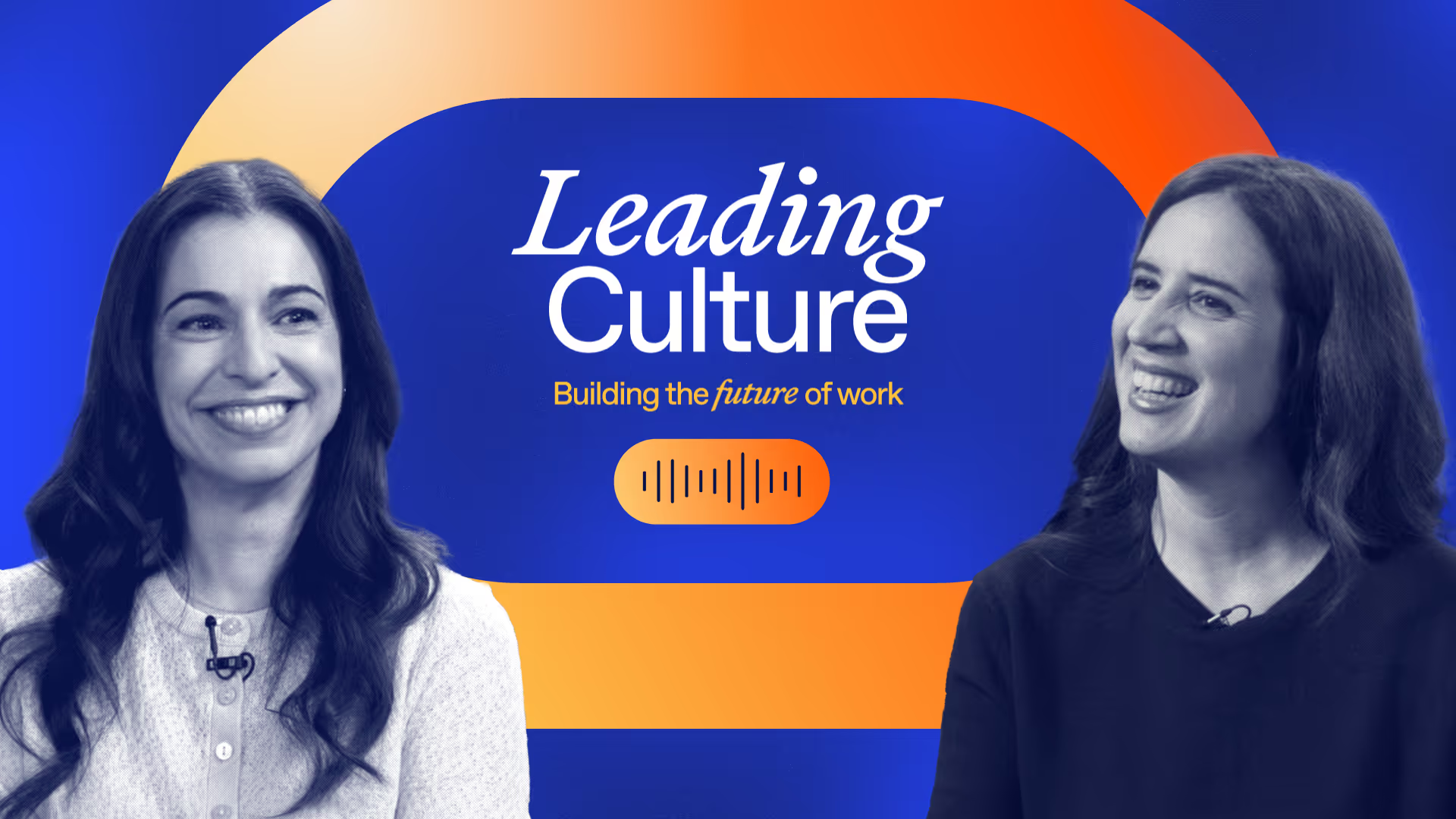
Scaling Culture, Remotely (Katya Laviolette, CPO at 1Password, and Kahina Ouerdane, CPO at Workleap)

How do you scale fast without losing what makes your culture special? In this episode, Workleap’s CPO Kahina Ouerdane sits down with Katya Laviolette, CPO at 1Password, to talk about growing a global, remote team—while staying true to your values. They dive into codifying culture, onboarding with intention, and why clarity and candor are must-haves in a high-growth world.A must-listen for anyone building culture at scale.

Subscribe to the podcast

In the Leading HR Experiments podcast, HR and people leaders share the bold bets they’re making on their teams: what they tried, what worked (or didn’t), and what they learned along the way.

Episode transcipt

Katya - 00:00
There's a train. It's a very long train. And as you're scaling this company, there's some people who will stay on the train for the entire journey and they will grow with you, and that is phenomenal. There's other people who will join the train for a period of time, and then they'll see their station and they'll be like, it's time to go. We'll honor, we'll respect that. And then there's other people who will embark at another train station to continue on the journey.

Kahina - 00:20
It's a good analogy. Welcome back to Leading Culture: Building the Future of Work. I'm Kahina Ouerdane, Chief People Officer at Workleap. I've always truly believed in the power of collective intelligence, how people coming together can create something bigger than the sum of its parts. And that's actually what this podcast is all about. We're having real conversations about what it takes to lead in today's workplaces.

Today I'm joined by Katya Laviolette, Chief People Officer at 1Password. With over 30 years of experience with companies including Essence and CBC Radio-Canada, Katya has deep experience scaling global teams, grounding culture in purpose, and bringing a business lens to HR. Hi, Katya, welcome.

Katya - 01:02
Hi, Kahina. Pleasure to be with you.

Kahina - 01:04
I'm so happy you're here. Thank you for making the time. There's so much we can talk about today. I mean, we're talking about 1Password. It's a company that you've personally helped scale from 500 employees to 1,400. You have more than half of the workforce that's outside of Canada now. So there's so much that I want to ask you about regarding that. Let me dive right in. What does scaling culture mean to you in a distributed world?

Katya - 01:30
Well, just taking a step back, as you said, 1Password is a cybersecurity company. We're in six countries. When I joined about three and a half years ago, we were around the 500 mark. We were in four countries then. And basically we have grown extremely rapidly. In a short period of time, we're going to hit about 1,400 people. We had 40 back then. We had 78% of our workforce which was Canadian. And now we've kind of flipped that, and we're about 48% Canadian, still very proud of our Canadian roots.

And part of scaling the workforce is also the importance of ensuring that you're, in parallel, scaling and keeping the cultural foundations that are important to you.

Katya - 02:17
And so when you work in a remote environment, it's very important to use words or use behavior such as being very intentional, codifying things, writing them down. The world of tech moves rapidly and so part of our journey has been to ensure that the founders who founded the company — it'll be 20 years in July — that we keep what are the most important parts about founding this company intact and that we transfer those over the cycles of scaling.

And so when I joined, we started around talking about, well, what kind of makes this company tick. And we codified the values: lead with honesty, put people first, keep it simple. Our first version was much more corporate-speak. Our founders are not like that. We did focus groups. We involved a whole swath of different individuals with different backgrounds.

Katya - 03:16
We said we really have to codify what it means here and start with the values and then the behaviors, and then you basically put all that into our programming and then you iterate over time. And that's what we've done. And so this is very important to do intentionally. And that's the whole part of scaling: don't forget where you came from. Make sure you honor those pieces. Some pieces will leave as you build the journey and you scale, but there are some core elements that remain. And I think that's very critical when you're building a company in a high-growth environment.

Kahina - 03:49
Yeah, it's making me think about a few things because you're talking about stories. I think there's a power to mythology and stories and sometimes having those stories being repeated over and over. So you're talking about codification, but there's also the anecdotes that get passed down in history and those are sometimes very powerful. I've noticed, I've experienced that in our company as well.

I'm curious because I'm hearing you talk about being intentional and that's something we also say. And our company is smaller in size, but I think it's also facing the same thing. We were Montreal-based, now it's Canada-wide, even with employees in the US. So same idea, different scale.

One thing that I say that keeps me up at night — and I'm curious to hear you on this — is the cultural onboarding of leaders.

Kahina - 04:28
So yes, of course we codify, we have videos, we have all sorts of things. But how do you explain — my analogy is always, I want to talk to you about Italy and I'll make you pasta and I'll bring you Italian wine, I'll show you all my pictures, but you're not walking down the streets in Rome with me. How do you get that, you know, the tempo of acting on performance, the absence of hierarchy or not, the things that you would kind of capture down the hallway because you'd see the CEO talking to someone? How do you do that piece?

Katya - 04:57
Well, it's not easy and we actually have a very unique onboarding. But actually all that capturing of those pieces starts at the inception of applying to 1Password. And this has iterated over time because, you know, as things evolve.

So we've recently integrated things into “What is it to work at 1Password?” Like, let's be honest and make sure that when people are coming in and they're even just selecting to apply, that this is the place for them. It might not be. And so we start actually right in the employer branding piece. Then someone is selected, they come on board and when I started they said, okay, you're going to start on a Wednesday. And I'm like, Wednesday? Most people, the work week starts on Monday. And they're like, oh no, no.

Katya - 05:52
This is a remote company, there are so many tools, there's so much information. We actually do a three-day, very structured onboarding that has evolved as we've scaled, and we have an individual who has been with us for many years who actually can impart the culture and the stories, like you say, to get people onboarded. And at the same time, in parallel — that's the onboarding of the company — we have them meet the founders and then they onboard into their functions from there.

And so those are all elements that are very intentional. You know, we just don't throw someone in and say, okay, start. It's very structured. And we say, take those three days, don't do anything else except absorb how we work, what our expectations are, what our tools are.

Katya - 06:46
Get ready for the start with your manager and your team and so forth. And we go from there. And then we do very structured check-ins in terms of how things are going at the 3, 6, 9 months mark and so forth. And so those are well thought out. And it's very different from the days of bringing everyone together into the classroom because we're not like that, we don't have that. We're structured just very differently.

Kahina - 07:12
Yeah, interesting what you're saying. I'll take notes about that because one of the things we've been saying a lot is that software is your workplace, because everything is now happening through a screen. So having the time to kind of land into your new universe, which is what you're doing with your people, I find is really interesting.

Katya - 07:29
Yeah. And it takes time. You have to really absorb the information. And working remotely, people talk about it and they talk about, you know, there's this whole return to office and so forth. We are a remote company. We've been a remote company for over two decades, since the inception 20 years ago in July. And so we're very intentional about being remote.

However, it's not for everyone. Some people want to be in the office and so forth. So when they join, that's another thing that we talk about with candidates — are you sure you understand what it is to work remotely? Very, very important.

Kahina - 08:00
And that's interesting. And I think it's also probably a difference between your world and mine because we were a very on-site company until the pandemic hit. Right. We had just inaugurated our offices, everything. And even for a tech company, we were more presential than most tech companies were. So for us it was like a 180.

And I've been talking about this with colleagues of mine, saying the skill sets and the profiles of people sometimes who join a remote company might be slightly different from people who decide to join an on-site company. So I think it has also evolved in the profiles that we've been seeing. So yeah, it makes a lot of sense.

So we're talking about being really intentional about harmonizing the culture and the values and so on.

Kahina - 08:38
Have you, however, seen subcultures emerge, either geographically or by function or by leaders? I'm curious.

Katya - 08:45
Yes, and I think that is just a reality. You see that — my experience is I've seen that in every company. I think our job as HR professionals is to ensure that we're shepherding and setting a tone at the top from a cultural perspective. And then there will be subcultures.

The element of importance is making sure that those subcultures don't clash with the overall umbrella culture and that they live amongst themselves or cohabitate together. But yes, you're absolutely going to get a US–Canadian difference from a culture perspective, the UK, the Netherlands, you know, we will have all that. And that's okay. It's just making sure that everyone is kind of moving along in the same direction. That's what's critical.

Kahina - 09:38
And it's making me think about something I was discussing a few years back around the idea that as long as we believe in the same core values, the way we're going to be expressing those values is going to be different. So if you and I believe in physical activity, maybe if I live in Port-au-Prince, I'm not going to do my jogging the same way you're going to be doing in Montreal. I'm going to be doing something else. But we're still aligned on the principle. So I guess that's what you're kind of saying.

Katya - 09:59
Absolutely, yeah.

Kahina - 10:09
Another thing that I've been facing, and I'm so curious to hear you because of the scale that you've been working at, I'm very interested in how to bring people along the journey as we're scaling. And we were talking about that a little bit before — like you need sometimes certain types of profiles at a certain moment in time in a company and then sometimes it evolves and you need other types of profiles.

How do you play that out? Do you have a focus on internal mobility? Do you have runway and time to scale or to upgrade people's skills? Is it feasible — always, sometimes? What's the approach there?

Katya - 10:31
I would say it's a blend of everything. When I joined, we were 500. We were coming off a Series C raise with significant investors out of the Bay Area. We actually were the largest fundraise at the time in Canada — we're very proud of that. And the mandate was very rapidly to grow the business because we were coming from a B2C into a… we had started to get into a B2B sales motion and now we're actually going from what I would kind of call single product into multi-product.

And so it's very important on that kind of scaling journey that you have individuals who have come with you that you can continue to develop and who will continue to grow with the company.

Katya - 11:16
And then you need to also start to bring in — when you do start changing, you know, your product, your target audience and so forth — there are skills, if you're going very quickly, that you need to buy, you do not have time to develop. So it's really a blend of everything together.

And I say very transparently that it's analogous — the latest analogy I'm using, I like to use analogies — is that there's a train, it's a very long train. And as you're scaling this company, there's some people who will stay on the train for the entire journey and they—

Kahina - 11:49
Will grow with you.

Katya - 11:51
And that is phenomenal. There's other people who will join the train for a period of time and then they'll see their station and they'll be like, it's time to go. We'll honor, we'll respect that. And then there's other people who will embark at another train station to continue on the journey.

Kahina - 12:04
That's a good analogy.

Katya - 12:05
And that is what is happening. You've got the pressure to go quickly. It has to be a blended approach. And we're hiring phenomenal people. We have phenomenal people that have been with us from the journey. And everyone needs to be able to evolve together and we need to have frank discussions. If we can't necessarily all evolve together, then let's talk about that.

Kahina - 12:28
I feel like we save so much time when we are honest and blunt about things. We're talking about this and the importance of that. Brené Brown says, “Being clear is being kind.” I really believe it. It's one of our values, saying it like it is. And I've seen so many conflicts or so many issues that could have been prevented had we just, you know, said it like it was.

And I think we're talking about — I'm talking about collective intelligence, but also harmonizing action of employees together because basically at the end of the day, we're kind of conductors trying to make the most out of the music. I think that resonates with both of us. And in the job that we have, we are facing conflicts and conflict resolution and those kinds of things because it's part of the journey.

Kahina - 13:11
So how do you help leaders navigate that — having those tough conversations? I feel like it's a topic that everyone talks about all the time. How to have the courage and the audacity to be able to… I'm curious to hear you on this.

Katya - 13:23
I actually think that it is part of our job as HR professionals to be able to work in that environment. There's always going to be conflict, no matter what — personal, professional, you name it — and it's actually increased over the last few years given all the dynamics in the workplace, marketplace changes, economics and so on and so forth.

And our job is to be able to identify those things and when you see that, get it out on the table in a very… I use the word, I always say, come back to the facts, take out the emotions, judge your time to be able to address this. If it's not a good time to be able to address the conflict because people just are not in the headspace, then you need to be able to choose the right time.

Katya - 14:06
But our job as HR professionals is to really bring that out and get to a decision on top of it. When you're dealing in very fast-paced, changing environments, you need to be even, I would say, clearer, faster. And so these elements of addressing conflict are very critical.

And so I just think that it is one really common element that any leader should have. But as HR professionals, I think we have a lot of opportunity to influence and impact that. And, you know, you add on top of that a remote environment — yeah, you don't know a lot that's going on behind the screen. You see someone from here up. And so you even have to have, as a leader, an even greater sense as to what's going on.

Katya - 14:56
So you need to listen, you need to watch the body language and you need to really draw out things. So clarity and directness, I just think it's so important because we can just waste our time spinning.

Kahina - 15:08
Yeah. Do you feel that it's a skill that can develop itself or do you feel that we have to hire people who already have that?

Katya - 15:17
That one I think you can develop. I think that it is something that we don't emphasize enough. Someone was talking to me a couple of years ago just about, you know, my career trajectory and I actually didn't realize it. They were saying, hey, can you explain where you come from and what you've done?

And my first job was like in the trenches in labor relations with the Canadian Auto Workers. I was like, I don't know, 24 or 25 and, you know, doing labor negotiations. And that was tough. Only woman at the table, didn't speak a lot of French. And the person said to me — and it took me like, I don't know, most of my career to figure that out — they were like, oh, that's why you're good at really dealing with things head on. It's because that's where you come from.

Katya - 16:05
So I've had that experience and then it's obviously been supplemented by other experiences in different companies and different industries. But I believe you can learn this skill and you have to get comfortable with it. It's okay. It's okay to have conflict.

Kahina - 16:21
It's interesting because a few years back we provided a training, first to all managers and eventually to all employees, on non-verbal communication. So it was like a two-day training. And it was interesting to see how there was a common vocabulary coming out of this — you know, stating the facts and then the needs and then the emotions as an indicator of a need, and then coming up with a request and so on.

And so years later, for those who experienced that training, some of them still had the language. What I find difficult at times is to be able to make the time.

Katya - 16:51
You need to make the time. You need to practice.

Kahina - 16:53
Exactly. It's making the time and it's practicing over and over. But especially in a fast-paced environment that you and I are experiencing, how do you carve out two full days for all managers to do this again?

You know, as I'm saying this, I'm making a note to myself that maybe I should explore that again years later because the workforce has changed quite a bit. It's changed.

Katya - 17:11
You're expanding too. You're in different countries.

Kahina - 17:14
Yeah, I would agree. See, this is valuable. So one of the things that we've been very intentional about in my world in the past years has been to tell managers about the importance for them to navigate ambiguity and uncertainty. So, you know, people are asking for answers and sometimes we don't have the answers and sometimes it's a pick-your-poison situation and helping them navigate that.

So I'm curious to hear you on this. How do you help — I'm sure you're experiencing the same need — how do you help managers navigate ambiguity and uncertainty in a world that keeps on changing really fast?

Katya - 17:41
Yes.

Kahina - 17:41
How do you help managers navigate ambiguity and uncertainty in a world that keeps changing really fast?

Katya - 17:46
The bottom line is I think you need to be able to say, when I talk to a manager or leader about this, that it's okay that you don't have the answer. You need to tell them you don't have the answer. You need to listen. You need to figure it out sometimes together, but don't not respond. That's the worst thing.

And in these environments — Slack is our main communication tool, you love it or you hate it at the same time — things go by very quickly. And I think it's also a platform in which you can actually respond to people and be honest and direct about what you know and what you don't know. I mean, we're dealing with product development and, you know, moving through the product development cycle.

Katya - 18:32
And we have, in security, an industry where we are taking care of people's privacy and security and so people care about that. It's a mission-driven company and people have a lot of opinions around that and they want to hear leaders on that. And I think sometimes leaders are like — they get nervous that, you know, employees are very direct these days. It's not like the olden days at all. It's because information and technology is much more fluid.

And I'm like, that's okay. The only thing that's not okay is when people don't direct it in a respectful manner or a manner of curiosity — and you should call them out on that. But other than that, if you don't have the answer, just say it and try and figure it out as you go.

Katya - 19:18
But just not to respond is not good.

Kahina - 19:20
But it's true that being clear is like the first step. And even if you don't have — you don't give certainty by being clear, at least you're being clear. That's already a step in the right direction. Yes, and I think you're right. It helps people navigate the rest — that's the unknown.

And speaking of the unknown, one thing that I think we both realized that we had in common is the fact that we have both jumped into the unknown at certain moments in our lives and in our careers. Because I was a human rights lawyer before and then jumped into the management consulting world and then to what I am today. And you also changed industries — worked in retail, worked in CBC, housing, Canada, now working in tech.

Kahina - 19:57
So I'm first of all curious to hear you on your trajectory and also what you think is the importance of being adaptable and agile as an HR professional in the world that we live in today?

Katya - 20:10
Well, it's a fascinating question because I do believe that there's so much more opportunity. Someone was asking me the other day, you know, about leadership paths. They were asking this question about, you know, like, do you think there's one that's better than another?

Kahina - 20:23
And I'm like, no.

Katya - 20:24
I said the world is so open. When I, you know, got out of university, it was like, here are the ten jobs you should do and that's it, that's all. So my career has been — I say yes, 30-year veteran, three decades in the HR field and pretty well every sub-function. But most of my career has been in very large companies, multinational, publicly traded.

And about six years ago I just decided, you know, it was time to do something different. I actually wasn't sure — I left the publicly traded world. But the one thing that I knew, which was like we say in French a fil conducteur that carried through my career, was around founders and entrepreneurs. And so I shifted into the private space and worked, and have been working solely, with entrepreneurs and founders in terms of scaling companies.

Katya - 21:13
And sometimes your career leads you. It's not always a straight line. You sometimes throw yourself into things and you're like, I wonder if it's going to work. And it was like the best decision I ever made because I have all these years of experience in very different businesses.

But at the end of the day, the HR piece — if you understand the craft and how it works and how it evolves and you can figure out the business you're in and the culture you want to create — it's very transferable. And so I think the pivoting piece is very important. You can pivot at any time in your stage or age of your career. The beauty about the human resources craft is it's more malleable than other specific functions that might be very, very technical.

Katya - 21:59
You have to understand the human psyche, you have to understand the business and how to put all that together. But it's a very rewarding career if you can move and you can be agile. And I would say like the last five, six years, it's tough — it's a tough profession. And so you better want to be agile, you better want to be curious and continue to learn and so forth. Because if you're not, then you should probably be doing something different because it changes on a daily basis, for sure.

Kahina - 22:30
And I want to go back to your path. But before that, just one thing that emerged in my mind as we're talking — I feel like those skill sets that you can transfer and apply from one industry to another is something that's also true for different types of work.

And so one thing that I'm very adamant about, and I have debates also on my team about this, is when the time for recruitment comes, what's the approach? And very often we're looking for people who have done the exact same thing before, you know, B2B, SaaS, 100-whatever, because we want to be able to have a copy-paste type of thing. Although afterwards we'll ask people for innovation and we have to differentiate ourselves from the rest of the market.

Kahina - 23:11
So there's something that's a bit ironic there, but something that I find we underlook or we overlook is the skill sets that are transferable, sometimes even not only from an industry, but sometimes even from one type of work to another. And that's why I think personally internal mobility is something I would like to give more importance to internally because I think it's possible and sometimes we save ourselves a lot of time and a lot of energy and we see people thrive in a different way.

And it's also true when we recruit those people externally. Some people have the skill sets there, but they've done it in a very different setup in a different country. And it's transferable. So it's making me think about that.

Katya - 23:50
As you're saying, it's a very relevant point. I mean, for us, we work in a highly technical industry and we do have internal mobility. We have people who come in who live and breathe the consumer product, who come in and they help in the customer experience area and they start there. And then we've had great success stories of people becoming software developers or going to work in security from there and being able to navigate into different areas of the company.

So it's actually kind of a double track. You have internal mobility and at the same time you're complementing with skills that you do have to buy from external. But I think if you can identify if someone has the drive and the desire to want to build and develop, I think that sometimes that can exceed just the technical piece that's needed.

Katya - 24:42
And, you know, again, there are a number of functions that cut across the swath of all companies.

Kahina - 24:49
That's it.

Katya - 24:50
I'm a case in point. Like, I do not come from SaaS, I do not come from security. I come from very different organizations. What I had to really do was understand: ooh, this is a very different mindset, a very different culture from what I've been in. And so it's up to me to adapt and navigate and try and impact and influence as I go forward. But I do know the craft of HR.

Kahina - 25:17
Yeah, yeah. And one thing that's coming out from our conversation for me is the fact that we're really at the heart of dynamics: human dynamics, interactions, power dynamics. That's what a company and organization is all about. And linked to that is the importance of governance and how we govern a company and so on.

And I know that's something that's also dear to your heart — the governance component of how we run a business. So I'm curious to hear you a little bit on that. What's your view of how governance should be? What's the type of work that you're doing in that sense outside of your… I was going to say nine to five. I don't know if it's nine to five — how much you, People Officer role at 1Password.

Katya - 25:51
Well, part of my career trajectory, what I hold near and dear to my heart is taking my experience and putting it into kind of the next phase of my career, which is board and advisory work. So continuing that fil conducteur of helping entrepreneurs and founders and working either at a board level or an advisory level on the side of my kind of full-time operating role.

Because I believe that everything that an operator does in life is like a whole sum of experiences that you can help at the board level in setting good governance and helping companies grow, but in a different capacity — either advising or actually being a board director.

Katya - 26:38
And I think that we're seeing more and more, you know — I think about examples in the tech sector of private companies scaling and moving forward and building their boards. They want to have very seasoned operators who also have board and governance experience. So it's a really good blend and we're seeing also that change more and more on the board front.

You look at boards these days — I'm a big proponent of ensuring that when you're building a board, you have talent. Talent is a profile. You should have someone who understands talent. It's not just risk, it's not just audit and so forth. And the other thing we're seeing that is really pushing the envelope is cybersecurity and technology experience.

Katya - 27:23
It will bring the average age of board members down because this is a phenomenon and it's a very critical risk and governance phenomenon. So you're starting to see even those changes at the board level.

Kahina - 27:37
It's very interesting. What's top of mind for you right now aside from that?

Katya - 27:41
Well, there's a lot. I mean, people will probably roll their eyes, but there's a ton going on on the AI side. We talk about it within our product, within our culture, within the talent that we're hiring. It's going fast. We have unknowns — questions of ethics, questions of security and so forth. But what we know is that we cannot hide from it. We need to be curious. We need to embrace it. We need to look at tools that are going to help us.

And that's exactly what we're doing at 1Password. It's very critical for the product and for the security industry as a whole. And so that is… it's not this, you know, we had, I don't know, the whole inception of the Internet — yes, that was a huge change — but this change is like 10x, 100x.

Kahina - 28:29
Thank you so much, Katya, for your time.

Katya - 28:31
Thank you, Kahina. It's been a pleasure, it's been really a real pleasure to be on your podcast.

Kahina - 28:35
Thank you, thank you.
Keep listening

Culture first podcasts
December 3, 2025

How One HR Team Used AI to Unlock Time for Strategy and Impact

Enroll in course
Get this resource
Get this resource
Watch now
Culture first podcasts
May 7, 2025

Leading Through Change with Intent (Afroditi Ladovrechis, CPO at Innocap, and Kahina Ouerdane, CPO at Workleap)

Enroll in course
Get this resource
Get this resource
Watch now
Culture first podcasts
August 14, 2025

What if HR and IT weren’t separate functions, but one team? (Manuela Paoletta, SVP of People and Culture at AlayaCare, and Kahina Ouerdane, CPO at Workleap)

Enroll in course
Get this resource
Get this resource
Watch now

Katya - 00:00
There's a train. It's a very long train. And as you're scaling this company, there's some people who will stay on the train for the entire journey and they will grow with you, and that is phenomenal. There's other people who will join the train for a period of time, and then they'll see their station and they'll be like, it's time to go. We'll honor, we'll respect that. And then there's other people who will embark at another train station to continue on the journey.

Kahina - 00:20
It's a good analogy. Welcome back to Leading Culture: Building the Future of Work. I'm Kahina Ouerdane, Chief People Officer at Workleap. I've always truly believed in the power of collective intelligence, how people coming together can create something bigger than the sum of its parts. And that's actually what this podcast is all about. We're having real conversations about what it takes to lead in today's workplaces.

Today I'm joined by Katya Laviolette, Chief People Officer at 1Password. With over 30 years of experience with companies including Essence and CBC Radio-Canada, Katya has deep experience scaling global teams, grounding culture in purpose, and bringing a business lens to HR. Hi, Katya, welcome.

Katya - 01:02
Hi, Kahina. Pleasure to be with you.

Kahina - 01:04
I'm so happy you're here. Thank you for making the time. There's so much we can talk about today. I mean, we're talking about 1Password. It's a company that you've personally helped scale from 500 employees to 1,400. You have more than half of the workforce that's outside of Canada now. So there's so much that I want to ask you about regarding that. Let me dive right in. What does scaling culture mean to you in a distributed world?

Katya - 01:30
Well, just taking a step back, as you said, 1Password is a cybersecurity company. We're in six countries. When I joined about three and a half years ago, we were around the 500 mark. We were in four countries then. And basically we have grown extremely rapidly. In a short period of time, we're going to hit about 1,400 people. We had 40 back then. We had 78% of our workforce which was Canadian. And now we've kind of flipped that, and we're about 48% Canadian, still very proud of our Canadian roots.

And part of scaling the workforce is also the importance of ensuring that you're, in parallel, scaling and keeping the cultural foundations that are important to you.

Katya - 02:17
And so when you work in a remote environment, it's very important to use words or use behavior such as being very intentional, codifying things, writing them down. The world of tech moves rapidly and so part of our journey has been to ensure that the founders who founded the company — it'll be 20 years in July — that we keep what are the most important parts about founding this company intact and that we transfer those over the cycles of scaling.

And so when I joined, we started around talking about, well, what kind of makes this company tick. And we codified the values: lead with honesty, put people first, keep it simple. Our first version was much more corporate-speak. Our founders are not like that. We did focus groups. We involved a whole swath of different individuals with different backgrounds.

Katya - 03:16
We said we really have to codify what it means here and start with the values and then the behaviors, and then you basically put all that into our programming and then you iterate over time. And that's what we've done. And so this is very important to do intentionally. And that's the whole part of scaling: don't forget where you came from. Make sure you honor those pieces. Some pieces will leave as you build the journey and you scale, but there are some core elements that remain. And I think that's very critical when you're building a company in a high-growth environment.

Kahina - 03:49
Yeah, it's making me think about a few things because you're talking about stories. I think there's a power to mythology and stories and sometimes having those stories being repeated over and over. So you're talking about codification, but there's also the anecdotes that get passed down in history and those are sometimes very powerful. I've noticed, I've experienced that in our company as well.

I'm curious because I'm hearing you talk about being intentional and that's something we also say. And our company is smaller in size, but I think it's also facing the same thing. We were Montreal-based, now it's Canada-wide, even with employees in the US. So same idea, different scale.

One thing that I say that keeps me up at night — and I'm curious to hear you on this — is the cultural onboarding of leaders.

Kahina - 04:28
So yes, of course we codify, we have videos, we have all sorts of things. But how do you explain — my analogy is always, I want to talk to you about Italy and I'll make you pasta and I'll bring you Italian wine, I'll show you all my pictures, but you're not walking down the streets in Rome with me. How do you get that, you know, the tempo of acting on performance, the absence of hierarchy or not, the things that you would kind of capture down the hallway because you'd see the CEO talking to someone? How do you do that piece?

Katya - 04:57
Well, it's not easy and we actually have a very unique onboarding. But actually all that capturing of those pieces starts at the inception of applying to 1Password. And this has iterated over time because, you know, as things evolve.

So we've recently integrated things into “What is it to work at 1Password?” Like, let's be honest and make sure that when people are coming in and they're even just selecting to apply, that this is the place for them. It might not be. And so we start actually right in the employer branding piece. Then someone is selected, they come on board and when I started they said, okay, you're going to start on a Wednesday. And I'm like, Wednesday? Most people, the work week starts on Monday. And they're like, oh no, no.

Katya - 05:52
This is a remote company, there are so many tools, there's so much information. We actually do a three-day, very structured onboarding that has evolved as we've scaled, and we have an individual who has been with us for many years who actually can impart the culture and the stories, like you say, to get people onboarded. And at the same time, in parallel — that's the onboarding of the company — we have them meet the founders and then they onboard into their functions from there.

And so those are all elements that are very intentional. You know, we just don't throw someone in and say, okay, start. It's very structured. And we say, take those three days, don't do anything else except absorb how we work, what our expectations are, what our tools are.

Katya - 06:46
Get ready for the start with your manager and your team and so forth. And we go from there. And then we do very structured check-ins in terms of how things are going at the 3, 6, 9 months mark and so forth. And so those are well thought out. And it's very different from the days of bringing everyone together into the classroom because we're not like that, we don't have that. We're structured just very differently.

Kahina - 07:12
Yeah, interesting what you're saying. I'll take notes about that because one of the things we've been saying a lot is that software is your workplace, because everything is now happening through a screen. So having the time to kind of land into your new universe, which is what you're doing with your people, I find is really interesting.

Katya - 07:29
Yeah. And it takes time. You have to really absorb the information. And working remotely, people talk about it and they talk about, you know, there's this whole return to office and so forth. We are a remote company. We've been a remote company for over two decades, since the inception 20 years ago in July. And so we're very intentional about being remote.

However, it's not for everyone. Some people want to be in the office and so forth. So when they join, that's another thing that we talk about with candidates — are you sure you understand what it is to work remotely? Very, very important.

Kahina - 08:00
And that's interesting. And I think it's also probably a difference between your world and mine because we were a very on-site company until the pandemic hit. Right. We had just inaugurated our offices, everything. And even for a tech company, we were more presential than most tech companies were. So for us it was like a 180.

And I've been talking about this with colleagues of mine, saying the skill sets and the profiles of people sometimes who join a remote company might be slightly different from people who decide to join an on-site company. So I think it has also evolved in the profiles that we've been seeing. So yeah, it makes a lot of sense.

So we're talking about being really intentional about harmonizing the culture and the values and so on.

Kahina - 08:38
Have you, however, seen subcultures emerge, either geographically or by function or by leaders? I'm curious.

Katya - 08:45
Yes, and I think that is just a reality. You see that — my experience is I've seen that in every company. I think our job as HR professionals is to ensure that we're shepherding and setting a tone at the top from a cultural perspective. And then there will be subcultures.

The element of importance is making sure that those subcultures don't clash with the overall umbrella culture and that they live amongst themselves or cohabitate together. But yes, you're absolutely going to get a US–Canadian difference from a culture perspective, the UK, the Netherlands, you know, we will have all that. And that's okay. It's just making sure that everyone is kind of moving along in the same direction. That's what's critical.

Kahina - 09:38
And it's making me think about something I was discussing a few years back around the idea that as long as we believe in the same core values, the way we're going to be expressing those values is going to be different. So if you and I believe in physical activity, maybe if I live in Port-au-Prince, I'm not going to do my jogging the same way you're going to be doing in Montreal. I'm going to be doing something else. But we're still aligned on the principle. So I guess that's what you're kind of saying.

Katya - 09:59
Absolutely, yeah.

Kahina - 10:09
Another thing that I've been facing, and I'm so curious to hear you because of the scale that you've been working at, I'm very interested in how to bring people along the journey as we're scaling. And we were talking about that a little bit before — like you need sometimes certain types of profiles at a certain moment in time in a company and then sometimes it evolves and you need other types of profiles.

How do you play that out? Do you have a focus on internal mobility? Do you have runway and time to scale or to upgrade people's skills? Is it feasible — always, sometimes? What's the approach there?

Katya - 10:31
I would say it's a blend of everything. When I joined, we were 500. We were coming off a Series C raise with significant investors out of the Bay Area. We actually were the largest fundraise at the time in Canada — we're very proud of that. And the mandate was very rapidly to grow the business because we were coming from a B2C into a… we had started to get into a B2B sales motion and now we're actually going from what I would kind of call single product into multi-product.

And so it's very important on that kind of scaling journey that you have individuals who have come with you that you can continue to develop and who will continue to grow with the company.

Katya - 11:16
And then you need to also start to bring in — when you do start changing, you know, your product, your target audience and so forth — there are skills, if you're going very quickly, that you need to buy, you do not have time to develop. So it's really a blend of everything together.

And I say very transparently that it's analogous — the latest analogy I'm using, I like to use analogies — is that there's a train, it's a very long train. And as you're scaling this company, there's some people who will stay on the train for the entire journey and they—

Kahina - 11:49
Will grow with you.

Katya - 11:51
And that is phenomenal. There's other people who will join the train for a period of time and then they'll see their station and they'll be like, it's time to go. We'll honor, we'll respect that. And then there's other people who will embark at another train station to continue on the journey.

Kahina - 12:04
That's a good analogy.

Katya - 12:05
And that is what is happening. You've got the pressure to go quickly. It has to be a blended approach. And we're hiring phenomenal people. We have phenomenal people that have been with us from the journey. And everyone needs to be able to evolve together and we need to have frank discussions. If we can't necessarily all evolve together, then let's talk about that.

Kahina - 12:28
I feel like we save so much time when we are honest and blunt about things. We're talking about this and the importance of that. Brené Brown says, “Being clear is being kind.” I really believe it. It's one of our values, saying it like it is. And I've seen so many conflicts or so many issues that could have been prevented had we just, you know, said it like it was.

And I think we're talking about — I'm talking about collective intelligence, but also harmonizing action of employees together because basically at the end of the day, we're kind of conductors trying to make the most out of the music. I think that resonates with both of us. And in the job that we have, we are facing conflicts and conflict resolution and those kinds of things because it's part of the journey.

Kahina - 13:11
So how do you help leaders navigate that — having those tough conversations? I feel like it's a topic that everyone talks about all the time. How to have the courage and the audacity to be able to… I'm curious to hear you on this.

Katya - 13:23
I actually think that it is part of our job as HR professionals to be able to work in that environment. There's always going to be conflict, no matter what — personal, professional, you name it — and it's actually increased over the last few years given all the dynamics in the workplace, marketplace changes, economics and so on and so forth.

And our job is to be able to identify those things and when you see that, get it out on the table in a very… I use the word, I always say, come back to the facts, take out the emotions, judge your time to be able to address this. If it's not a good time to be able to address the conflict because people just are not in the headspace, then you need to be able to choose the right time.

Katya - 14:06
But our job as HR professionals is to really bring that out and get to a decision on top of it. When you're dealing in very fast-paced, changing environments, you need to be even, I would say, clearer, faster. And so these elements of addressing conflict are very critical.

And so I just think that it is one really common element that any leader should have. But as HR professionals, I think we have a lot of opportunity to influence and impact that. And, you know, you add on top of that a remote environment — yeah, you don't know a lot that's going on behind the screen. You see someone from here up. And so you even have to have, as a leader, an even greater sense as to what's going on.

Katya - 14:56
So you need to listen, you need to watch the body language and you need to really draw out things. So clarity and directness, I just think it's so important because we can just waste our time spinning.

Kahina - 15:08
Yeah. Do you feel that it's a skill that can develop itself or do you feel that we have to hire people who already have that?

Katya - 15:17
That one I think you can develop. I think that it is something that we don't emphasize enough. Someone was talking to me a couple of years ago just about, you know, my career trajectory and I actually didn't realize it. They were saying, hey, can you explain where you come from and what you've done?

And my first job was like in the trenches in labor relations with the Canadian Auto Workers. I was like, I don't know, 24 or 25 and, you know, doing labor negotiations. And that was tough. Only woman at the table, didn't speak a lot of French. And the person said to me — and it took me like, I don't know, most of my career to figure that out — they were like, oh, that's why you're good at really dealing with things head on. It's because that's where you come from.

Katya - 16:05
So I've had that experience and then it's obviously been supplemented by other experiences in different companies and different industries. But I believe you can learn this skill and you have to get comfortable with it. It's okay. It's okay to have conflict.

Kahina - 16:21
It's interesting because a few years back we provided a training, first to all managers and eventually to all employees, on non-verbal communication. So it was like a two-day training. And it was interesting to see how there was a common vocabulary coming out of this — you know, stating the facts and then the needs and then the emotions as an indicator of a need, and then coming up with a request and so on.

And so years later, for those who experienced that training, some of them still had the language. What I find difficult at times is to be able to make the time.

Katya - 16:51
You need to make the time. You need to practice.

Kahina - 16:53
Exactly. It's making the time and it's practicing over and over. But especially in a fast-paced environment that you and I are experiencing, how do you carve out two full days for all managers to do this again?

You know, as I'm saying this, I'm making a note to myself that maybe I should explore that again years later because the workforce has changed quite a bit. It's changed.

Katya - 17:11
You're expanding too. You're in different countries.

Kahina - 17:14
Yeah, I would agree. See, this is valuable. So one of the things that we've been very intentional about in my world in the past years has been to tell managers about the importance for them to navigate ambiguity and uncertainty. So, you know, people are asking for answers and sometimes we don't have the answers and sometimes it's a pick-your-poison situation and helping them navigate that.

So I'm curious to hear you on this. How do you help — I'm sure you're experiencing the same need — how do you help managers navigate ambiguity and uncertainty in a world that keeps on changing really fast?

Katya - 17:41
Yes.

Kahina - 17:41
How do you help managers navigate ambiguity and uncertainty in a world that keeps changing really fast?

Katya - 17:46
The bottom line is I think you need to be able to say, when I talk to a manager or leader about this, that it's okay that you don't have the answer. You need to tell them you don't have the answer. You need to listen. You need to figure it out sometimes together, but don't not respond. That's the worst thing.

And in these environments — Slack is our main communication tool, you love it or you hate it at the same time — things go by very quickly. And I think it's also a platform in which you can actually respond to people and be honest and direct about what you know and what you don't know. I mean, we're dealing with product development and, you know, moving through the product development cycle.

Katya - 18:32
And we have, in security, an industry where we are taking care of people's privacy and security and so people care about that. It's a mission-driven company and people have a lot of opinions around that and they want to hear leaders on that. And I think sometimes leaders are like — they get nervous that, you know, employees are very direct these days. It's not like the olden days at all. It's because information and technology is much more fluid.

And I'm like, that's okay. The only thing that's not okay is when people don't direct it in a respectful manner or a manner of curiosity — and you should call them out on that. But other than that, if you don't have the answer, just say it and try and figure it out as you go.

Katya - 19:18
But just not to respond is not good.

Kahina - 19:20
But it's true that being clear is like the first step. And even if you don't have — you don't give certainty by being clear, at least you're being clear. That's already a step in the right direction. Yes, and I think you're right. It helps people navigate the rest — that's the unknown.

And speaking of the unknown, one thing that I think we both realized that we had in common is the fact that we have both jumped into the unknown at certain moments in our lives and in our careers. Because I was a human rights lawyer before and then jumped into the management consulting world and then to what I am today. And you also changed industries — worked in retail, worked in CBC, housing, Canada, now working in tech.

Kahina - 19:57
So I'm first of all curious to hear you on your trajectory and also what you think is the importance of being adaptable and agile as an HR professional in the world that we live in today?

Katya - 20:10
Well, it's a fascinating question because I do believe that there's so much more opportunity. Someone was asking me the other day, you know, about leadership paths. They were asking this question about, you know, like, do you think there's one that's better than another?

Kahina - 20:23
And I'm like, no.

Katya - 20:24
I said the world is so open. When I, you know, got out of university, it was like, here are the ten jobs you should do and that's it, that's all. So my career has been — I say yes, 30-year veteran, three decades in the HR field and pretty well every sub-function. But most of my career has been in very large companies, multinational, publicly traded.

And about six years ago I just decided, you know, it was time to do something different. I actually wasn't sure — I left the publicly traded world. But the one thing that I knew, which was like we say in French a fil conducteur that carried through my career, was around founders and entrepreneurs. And so I shifted into the private space and worked, and have been working solely, with entrepreneurs and founders in terms of scaling companies.

Katya - 21:13
And sometimes your career leads you. It's not always a straight line. You sometimes throw yourself into things and you're like, I wonder if it's going to work. And it was like the best decision I ever made because I have all these years of experience in very different businesses.

But at the end of the day, the HR piece — if you understand the craft and how it works and how it evolves and you can figure out the business you're in and the culture you want to create — it's very transferable. And so I think the pivoting piece is very important. You can pivot at any time in your stage or age of your career. The beauty about the human resources craft is it's more malleable than other specific functions that might be very, very technical.

Katya - 21:59
You have to understand the human psyche, you have to understand the business and how to put all that together. But it's a very rewarding career if you can move and you can be agile. And I would say like the last five, six years, it's tough — it's a tough profession. And so you better want to be agile, you better want to be curious and continue to learn and so forth. Because if you're not, then you should probably be doing something different because it changes on a daily basis, for sure.

Kahina - 22:30
And I want to go back to your path. But before that, just one thing that emerged in my mind as we're talking — I feel like those skill sets that you can transfer and apply from one industry to another is something that's also true for different types of work.

And so one thing that I'm very adamant about, and I have debates also on my team about this, is when the time for recruitment comes, what's the approach? And very often we're looking for people who have done the exact same thing before, you know, B2B, SaaS, 100-whatever, because we want to be able to have a copy-paste type of thing. Although afterwards we'll ask people for innovation and we have to differentiate ourselves from the rest of the market.

Kahina - 23:11
So there's something that's a bit ironic there, but something that I find we underlook or we overlook is the skill sets that are transferable, sometimes even not only from an industry, but sometimes even from one type of work to another. And that's why I think personally internal mobility is something I would like to give more importance to internally because I think it's possible and sometimes we save ourselves a lot of time and a lot of energy and we see people thrive in a different way.

And it's also true when we recruit those people externally. Some people have the skill sets there, but they've done it in a very different setup in a different country. And it's transferable. So it's making me think about that.

Katya - 23:50
As you're saying, it's a very relevant point. I mean, for us, we work in a highly technical industry and we do have internal mobility. We have people who come in who live and breathe the consumer product, who come in and they help in the customer experience area and they start there. And then we've had great success stories of people becoming software developers or going to work in security from there and being able to navigate into different areas of the company.

So it's actually kind of a double track. You have internal mobility and at the same time you're complementing with skills that you do have to buy from external. But I think if you can identify if someone has the drive and the desire to want to build and develop, I think that sometimes that can exceed just the technical piece that's needed.

Katya - 24:42
And, you know, again, there are a number of functions that cut across the swath of all companies.

Kahina - 24:49
That's it.

Katya - 24:50
I'm a case in point. Like, I do not come from SaaS, I do not come from security. I come from very different organizations. What I had to really do was understand: ooh, this is a very different mindset, a very different culture from what I've been in. And so it's up to me to adapt and navigate and try and impact and influence as I go forward. But I do know the craft of HR.

Kahina - 25:17
Yeah, yeah. And one thing that's coming out from our conversation for me is the fact that we're really at the heart of dynamics: human dynamics, interactions, power dynamics. That's what a company and organization is all about. And linked to that is the importance of governance and how we govern a company and so on.

And I know that's something that's also dear to your heart — the governance component of how we run a business. So I'm curious to hear you a little bit on that. What's your view of how governance should be? What's the type of work that you're doing in that sense outside of your… I was going to say nine to five. I don't know if it's nine to five — how much you, People Officer role at 1Password.

Katya - 25:51
Well, part of my career trajectory, what I hold near and dear to my heart is taking my experience and putting it into kind of the next phase of my career, which is board and advisory work. So continuing that fil conducteur of helping entrepreneurs and founders and working either at a board level or an advisory level on the side of my kind of full-time operating role.

Because I believe that everything that an operator does in life is like a whole sum of experiences that you can help at the board level in setting good governance and helping companies grow, but in a different capacity — either advising or actually being a board director.

Katya - 26:38
And I think that we're seeing more and more, you know — I think about examples in the tech sector of private companies scaling and moving forward and building their boards. They want to have very seasoned operators who also have board and governance experience. So it's a really good blend and we're seeing also that change more and more on the board front.

You look at boards these days — I'm a big proponent of ensuring that when you're building a board, you have talent. Talent is a profile. You should have someone who understands talent. It's not just risk, it's not just audit and so forth. And the other thing we're seeing that is really pushing the envelope is cybersecurity and technology experience.

Katya - 27:23
It will bring the average age of board members down because this is a phenomenon and it's a very critical risk and governance phenomenon. So you're starting to see even those changes at the board level.

Kahina - 27:37
It's very interesting. What's top of mind for you right now aside from that?

Katya - 27:41
Well, there's a lot. I mean, people will probably roll their eyes, but there's a ton going on on the AI side. We talk about it within our product, within our culture, within the talent that we're hiring. It's going fast. We have unknowns — questions of ethics, questions of security and so forth. But what we know is that we cannot hide from it. We need to be curious. We need to embrace it. We need to look at tools that are going to help us.

And that's exactly what we're doing at 1Password. It's very critical for the product and for the security industry as a whole. And so that is… it's not this, you know, we had, I don't know, the whole inception of the Internet — yes, that was a huge change — but this change is like 10x, 100x.

Kahina - 28:29
Thank you so much, Katya, for your time.

Katya - 28:31
Thank you, Kahina. It's been a pleasure, it's been really a real pleasure to be on your podcast.

Kahina - 28:35
Thank you, thank you.

Who’s talking

No items found.
No items found.

Table of contents

Don’t just believe the hype.
Experience it *yourself*.