Best salary benchmarking tools for fair and competitive pay


While you can’t build a world-class team on a bargain budget, overpaying people creates unstable finances, which may lead to layoffs.
That’s where salary benchmarking tools come in, guiding how you set defensible salary ranges across job roles, locations, and company sizes. Let’s review some of the best salary benchmarking tools and how to choose one.
Key features to look for in salary benchmarking tools
Many salary benchmarking tools only rely on salary surveys, leading to broad, outdated data. When looking for the right tool for your organization, try to find one that offers more features, like:
- Market data freshness and coverage: If the salary benchmarking data is outdated or thin, your salary ranges will be too. Strong tools pull from broad, current market data across industries, job titles, and company size.
- Pay percentile and range analysis: Look for clear views into percentiles, compa-ratios, and medians. With at-a-glance visuals, you’ll see benchmarks for each role and how your compensation compares.
- Pay equity and internal checks: The right platform flags gaps across gender, tenure, location, and department. Built-in pay equity analysis helps HR catch inconsistencies before they become compliance risks.
- Customization by role architecture: Job roles rarely match generic templates. Effective benchmarking tools let you map internal job titles and tasks to external market data, adjusting based on seniority, geography, and reporting structure.
- Transparent methodology: Reputable compensation data providers clearly explain their salary survey and reported data sources, sampling approach, and data-refresh timelines, so you always know if information is accurate.
The 7 best salary benchmarking tools
Here’s a breakdown of seven top compensation benchmarking tools to help you find the right fit.
1. Workleap Compensation
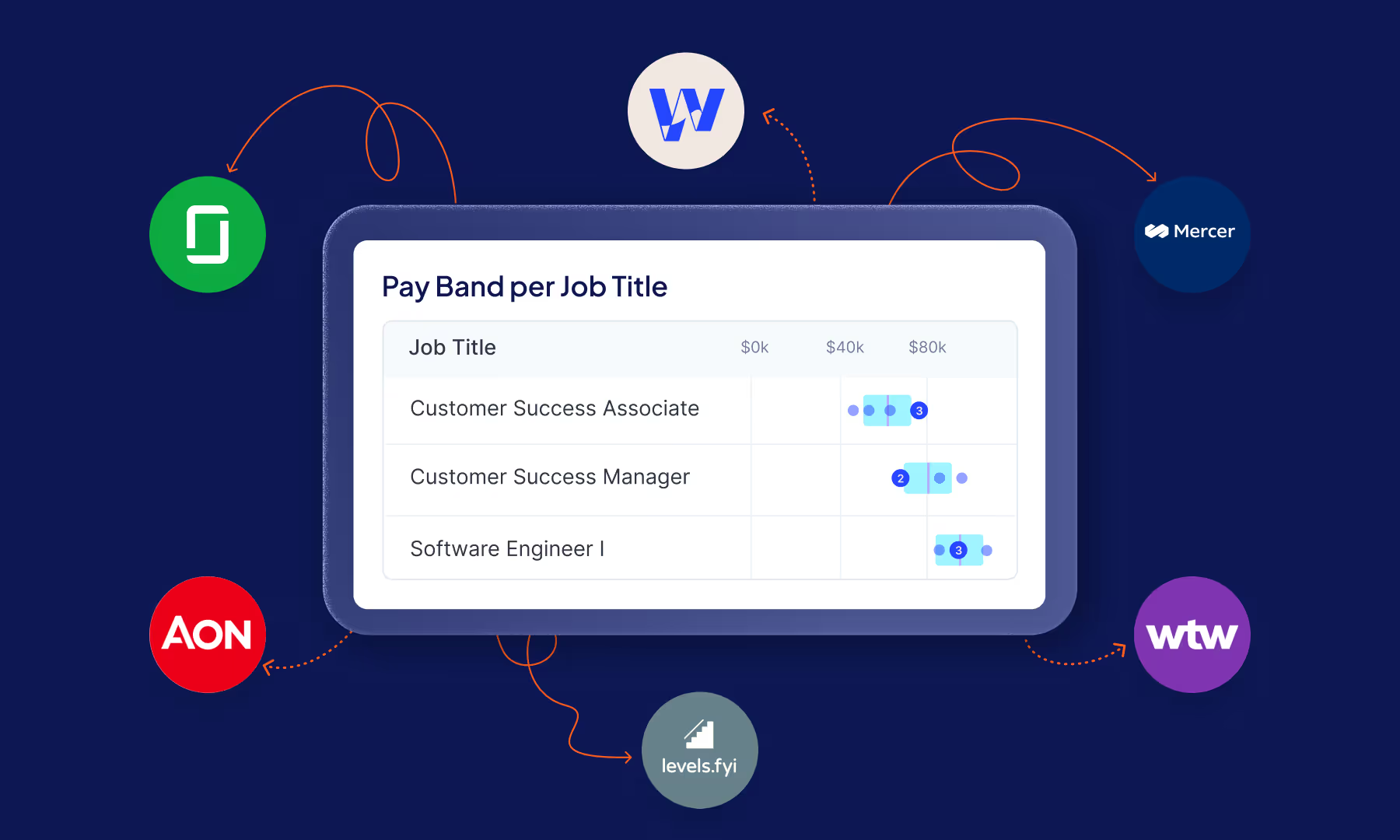
Workleap is a compensation management platform designed to help you make fair and defensible pay decisions. It integrates salary benchmarking data with easy-to-manage pay bands, compensation analytics, and global pay support.
Key features:
- Unified end-to-end compensation management
- Easy-to-manage pay bands and comparisons
- Global pay support and configurable compensation reviews
- Automated comp letter generation
- Multiple benchmarking sources
- Seamless HRIS and payroll integration
Best for:
- SMBs to large organizations seeking automated, scalable compensation management
Cons:
- Likely too comprehensive for those needing standalone salary survey results
- May offer more structure than early stage startups require
Pricing options:
- Free trial
- $5/user/month
2. Ravio
Ravio is a salary benchmarking tool that helps users create salary bands and identify pay gaps. The platform integrates with existing HRIS platforms to streamline compensation planning.
Features:
- Updated benchmarking and live market insights
- Compensation data 1,400 companies
- Automated job-level mapping to internal HR systems
- Salary band and pay equity analysis tools
- Integrations with 100 HRIS systems
Best for:
- High-growth tech companies and startups looking for a scalable framework
Cons:
- Primarily focused on tech and startup sectors (particularly in Europe), which may limit applicability for other industries
- May require effort to integrate and map roles within your existing HR system
Pricing options:
- Custom pricing based on company size, market data needs, and selected modules
3. Juicebox
Juicebox is a recruiting platform with an AI focus. Its PeopleGPT system scans 800 million profiles across 30 data sources to find estimated salary bands based on location and role. With this feature, hiring managers know what salary a candidate wants before the first conversation.
Features:
- Salary benchmarking data across roles and job postings
- AI-driven job mapping and salary checker tools
- Filters for location, company size, and industry
- Interactive salary checker
- Integrations with existing HRIS platforms
Best for:
- Recruiters and HR leaders at fast-moving SMBs
Cons:
- May lack multilayered visualizations of more complex platforms
- Offers minimal compliance and pay equity auditing features
Pricing options:
- Free trial
- Pricing based on team size and data access needs
4. Pave
Pave handles salary benchmarking and compensation planning. It integrates with HRIS, applicant tracking, and equity management systems, ensuring accurate data for compensation decisions.
Features:
- Integration of live market data into compensation planning workflows
- Benchmarks from 8,700 companies
- AI-powered job matching and predictive machine learning
- Rewards portals
- Visual compensation planners for merit increase cycles
Best for:
- Venture-backed startups and scaling tech companies that rely on equity to compete for talent
Cons:
- Ownership tracking may be overkill for some businesses
- Cost may be prohibitive for smaller firms
Pricing options:
- Market Data Lite: Compensation benchmarks from 8,700 companies, 200 job families, and 16 business functions
- Market Data Pro: Access to international benchmarks, more advanced reports, and more granular insights
- PaveOS: Market Data Pro plus other modules like compensation planning and total rewards portal
5. Carta Total Compensation
Total Compensation is an add-on product for paid Carta plans. It layers on top of foundational equity management packages and offers leveling, benchmarking, and total rewards statements.
Features:
- Real-time private market benchmarks
- Automated Scorecards to identify pay gaps and overspending
- Total Rewards statements that visualize the value of equity
- Integration with Carta’s cap table and 409A valuation tools
- Custom pay bands aligned with compensation strategies
Best for:
- Startups and high-growth companies that need a unified view of cash and equity
Cons:
- Existing customers get the best value
- More expensive than standalone salary benchmarking tools
Pricing options:
- Sold as an add-on to any existing Carta plan
6. CompAnalyst
CompAnalyst is an AI-powered compensation management platform designed for enterprises that need survey-backed pay data. With it, companies benchmark roles based on location and build structured, compliant pay programs.
Features:
- Integration with HRIS and payroll systems
- Automated job matching for accurate role alignment
- Market pricing from 25,000 organizations
- Compliant reporting workflows
- Modeling tools for salary structures, merit matrices, and incentive plans
Best for:
- Enterprise HR teams managing complex, multilocation programs
Cons:
- Potential for steeper learning curve than startup-focused tools
- Pricing tailored to enterprise budgets
Pricing options:
- Custom pricing
7. Compa
Compa is a compensation intelligence platform. It blends employee pay data with offers-based benchmarks sourced from hiring activity. By integrating with ATS and HR systems, it gives talent and compensation teams an overview of internal pay and external market movement.
Features:
- Benchmarking sourced from new hire job offers and current employee reported data
- Bi-weekly data syncs
- AI-powered guidance and compensation adjustment recommendations
- Skills-based analysis for pricing specialized roles
- Geographic pay differentials
Best for:
- U.S. enterprises (particularly in life sciences, retail, and tech) that need current market intelligence to compete for talent
Cons:
- Doesn’t provide full compensation management solutions
- Limited support for salary band design and pay equity analysis
Pricing options:
- Market data starting at $35,000 a year
- Custom pricing for agent access
How to choose the best salary benchmarking tool
These criteria will help you evaluate tools based on your company’s maturity, specialized roles, and long-term compensation strategy.
Define compensation goals
Do you simply want to avoid compensation mistakes? Is your primary focus implementing pay transparency? Your goals dictate if you need a tool that specializes in high-frequency, salary survey data.
Assess your internal job structure and role complexity
If your company has complex or evolving roles, your tool should support flexible job frameworks and handle nuanced role comparisons. On the other hand, brands with simpler or more standardized roles might prioritize ease of use and straightforward benchmarking data.
Match tool depth to company stage
Your company’s size and growth stage influence your tool choice. Early-stage startups may benefit from lightweight, offer-based benchmarking tools, while scaling companies often need compensation planning and review workflows. Choose a tool that can scale with you while still fitting your current needs.
Evaluate how benchmarking insights connect to real pay decisions
Look for tools that work within your existing communication workflows. Remember that the best options offer benchmarking insights that allow you to build actionable pay bands, review cycles, and make compensation a repeatable process.
Consider integration with existing HR or compensation workflows
Assess how well the tool integrates with your HRIS, ATS, payroll, and equity systems. Seamless data sync reduces manual entry and ensures benchmarking accurately reflects your real workforce data.
Turn salary benchmarking data into consistent pay decisions with Workleap
Benchmarking data is only valuable when it drives consistent, fair, and transparent pay decisions. Without structured workflows, market insights sit unused and create guesswork instead of clarity.
Workleap Compensation transforms raw data into action, using configurable pay bands, spend tracking, and built-in communications. With it, you’ll make repeatable, defensible compensation decisions across roles and locations. HR teams save time and reduce administrative work while ensuring pay equity.
Ready to turn market data into real impact? Request a demo of Workleap Compensation today, and make pay decisions smarter, faster, and more equitably.

.png)


%202%20(1).png)



.png)