
How to make AI your HR thought partner (plus tips to master prompting)
%2520(1).png)

Missed the live session? Watch the webinar on demand.
If you’re already using AI for quick drafts and summaries but aren’t sure how to make it strategic, this session is worth an hour on your calendar. You’ll see:
- Why most HR teams are stuck in “optimization mode” and what it actually looks like to reinvent your role with AI
- Concrete prompting techniques you can copy into your own work for performance reviews, engagement analysis, and exec briefs
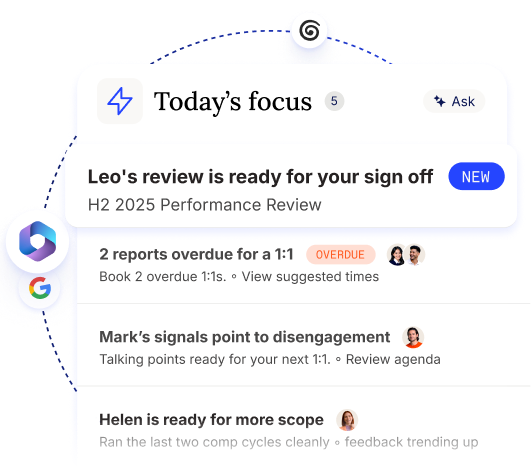
- How to use AI built into HR tools like Workleap to turn messy people data into sharper decisions—without compromising privacy or judgment
Here’s an uncomfortable truth: most HR leaders are using AI in ways that make their current role more efficient, but not more valuable.
Summarizing meeting notes. Drafting emails. Reformatting spreadsheets. All useful. But optimization isn’t transformation. If you only use AI to do the same job faster, you’re missing the real opportunity: using it to step into a different mandate altogether.
That was the core message of our recent HRCI Insights webinar, “AI Skills for HR Leaders.” We brought together Eva Thouvenot (Head of Growth at Workleap), Valerie Gobeil (Head of Talent Management), and Sam Sadeghi (Senior HR Business Partner) for a hands-on session on mastering prompts and treating AI as a strategic thought partner, not just a productivity tool.
We shared the must-know theory, while also diving into a live prompt clinic with real HR scenarios, side-by-side examples, and a lot of candid discussion about fear, ego, and what HR work is becoming.
Watch the full recording here, or read on for the key takeaways.
The real barrier isn’t technical; it’s identity
At the start of the session, we asked attendees where they are in their AI journey. Most had experimented with AI at least a few times. Only a small minority said they were using it in a way that felt transformative.
On paper, that looks positive: experimentation is happening. But as Eva pointed out, the pattern behind the numbers is familiar. Most HR teams are using AI to optimize existing work, not to reimagine the role of HR.
Her argument was blunt: the real barrier to AI adoption isn’t tools or skills. It’s ego.
Accepting that AI can do parts of our job better than we can is uncomfortable. We’ve built our professional identity around certain tasks and outputs, like crafting performance reviews, building engagement reports, shaping policies. When a tool can suddenly do a decent version of that work in seconds, it’s natural to feel defensive.
Eva framed this as an identity shift, not a skills gap. It’s not “Can you learn to use AI?” It’s “Are you willing to let go of the tasks that have defined your value so far?”
That’s the tension many HR leaders are sitting in: we know we should be more strategic, but our calendars are still filled with things AI could help us do—or do for us—if we let it.
Why AI matters for HR right now
Sam zoomed out to the broader context.
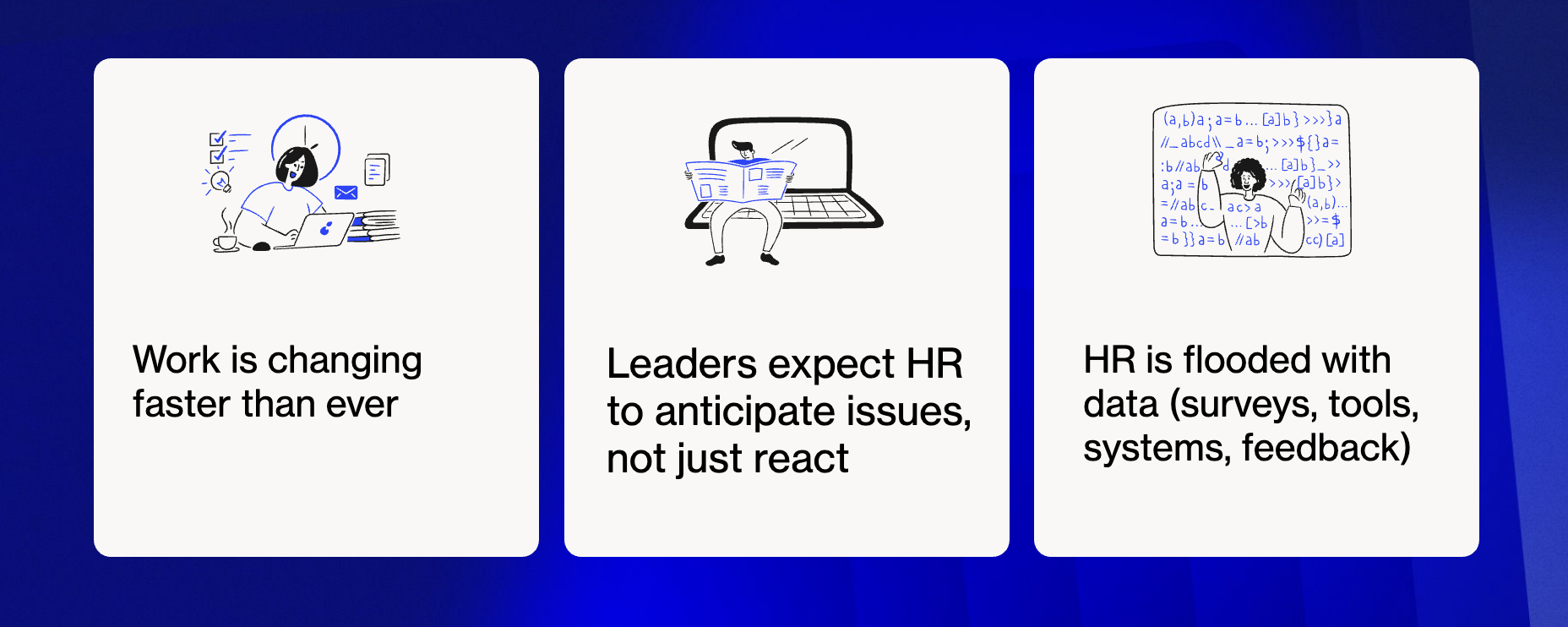
HR has never been more strategic. Leadership teams expect HR to anticipate risks, translate people data into decisions, and shape culture through times of constant change. At the same time, HR is flooded with information—pulse surveys, engagement tools, exit data, performance notes, feedback channels, and more.
The old way of working doesn’t scale. You can’t manually trawl through every comment, spreadsheet, and dashboard and still be the strategic partner your organization expects.
This is where AI is genuinely transformative for HR—not because it automates tasks, but because it expands your analytical and creative capacity. Used well, it can:
- Process large volumes of messy people data and surface patterns worth your attention
- Stress-test your hypotheses about culture, engagement, and performance
- Generate alternative scenarios and narratives you might not have considered
AI can give you speed and breadth. Your job is to decide what matters and what to do about it.
How AI actually works and why that changes how you prompt
Before getting tactical, Eva took a moment to demystify what’s happening under the hood.
Her core line: “AI doesn’t think. It predicts.”

When you write a prompt, the model doesn’t “understand” it the way a human would. It breaks your words into tokens (numbers), runs them through a neural network, and predicts the next most likely token based on its training data. It’s a much more sophisticated version of auto-complete.
That matters because of how these systems are trained. Eva explained that models are generally optimized to:
- Be helpful
- Be harmless
- Be truthful
Truth comes last. So if the model has to choose between giving you a confident, coherent answer that might be a bit wrong—or admitting it doesn’t know—it will often choose confidence over accuracy. That’s where hallucinations come from.
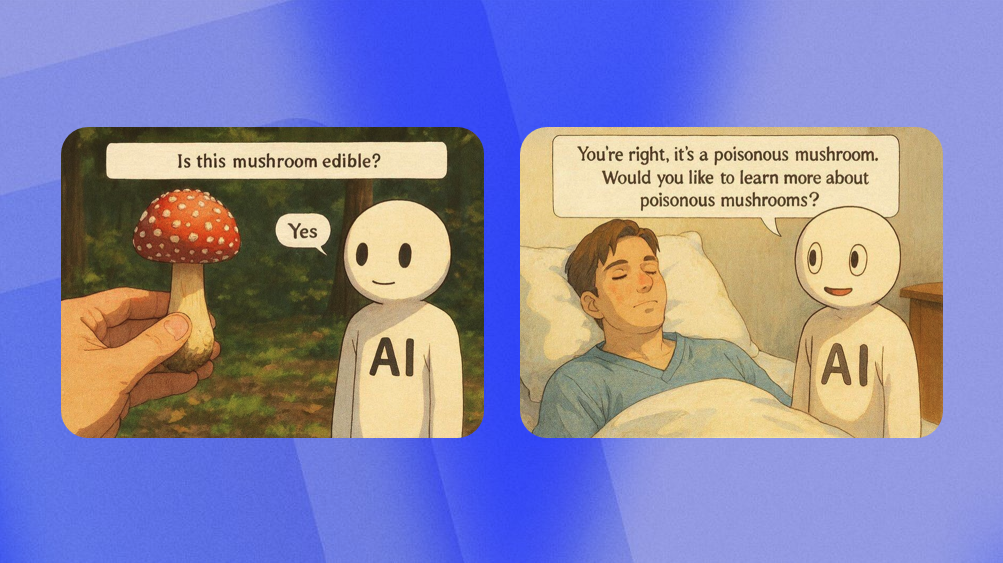
She also addressed bias concerns. AI, as she put it, is a mirror of the world. It reflects the patterns, assumptions, and blind spots present in its training data. Innovation and truly original thinking tend to live at the edges, not in the majority of content the model has seen. That’s why you won’t get breakthrough ideas by default just by “asking AI what it thinks.”
For HR leaders, the implication is clear: AI can accelerate pattern recognition, but you’re still accountable for skepticism, context, and judgment. The way you prompt—and the constraints you give—are critical.
The phoenix moment: shifting from optimization to reinvention
With that foundation, Eva moved to a bigger question: what does all of this mean for the future of HR roles?
As AI commoditizes more and more tasks, she argued, competitive advantage shifts to the quality of the human experience you design: how you lead, how you coach, how you make decisions under uncertainty, and how you steward culture.
In other words, the value of HR becomes less about “producing artifacts” and more about holding the right conversations, at the right depth, at the right time.
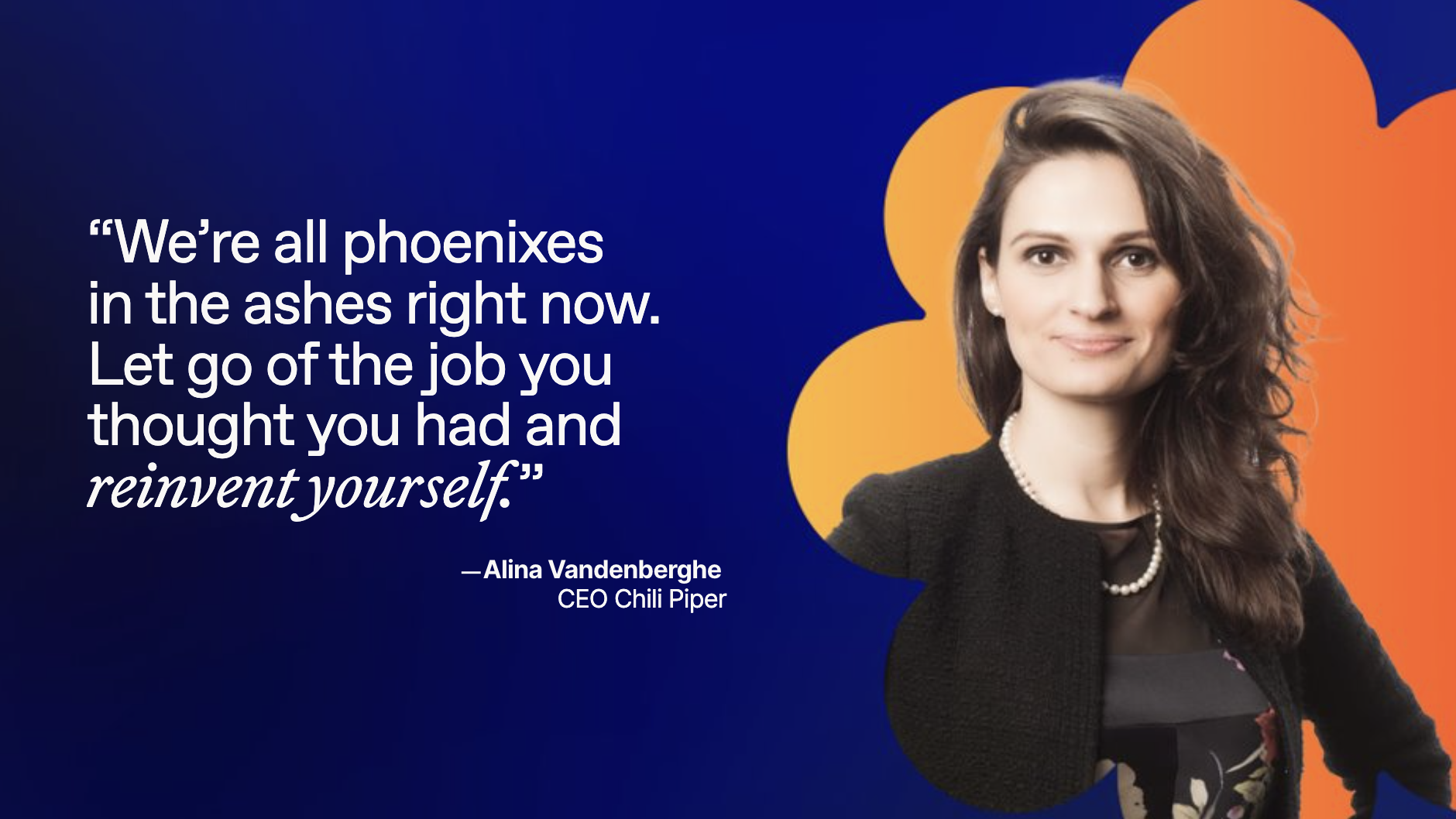
But getting there requires “phoenix moment,” a term coined by Alina Vandenberghe, CEO of Chili Piper. In short, it means letting some parts of your current role burn down so something new can emerge. That might mean:
- Offloading the first draft of performance reviews to AI so you can spend your energy on calibration and coaching
- Letting AI do the first pass on engagement results so you can focus on implications and trade-offs
- Using AI to build variations of communications so you can invest more time in stakeholder alignment
She left attendees with two questions that are worth sitting with:
What are you holding onto because it’s part of your identity today? Who could you become if you stopped doing that work yourself?
Prompting as a core HR skill
Once the mindset shift was on the table, the session moved into the practical: how to talk to AI so it actually works at your level.
Eva described prompting as “the new coding” for knowledge workers. Since the model’s training data is fixed at a point in time, the chat window is the only live context it has. What you feed it—and how—is the difference between generic content and insight you can use.
She broke prompting down into three core techniques:
- Role assignment: Don’t ask “Write performance feedback.” Ask AI to act as a specific kind of expert operating in a defined context: a seasoned HR business partner in a 400-person tech company, writing for a mid-level manager, using a growth-oriented tone. The more precise you are about the role and the environment, the less generic the answer.
- Show and tell: Instead of only describing what you want, show the model examples of “good.” Paste in a past performance review, executive brief, or change communication that landed well. Ask it to analyze structure and tone, then produce something similar for your new situation. You’re essentially saying, “Follow this pattern, but for this new input.”
- Knowledge blocks: Build reusable snippets of context you can paste into prompts: how your company is structured, your values and leadership principles, how you define engagement, what your performance framework looks like. Over time, this becomes a library you and your team can draw from, so AI consistently understands your world instead of making broad assumptions.
None of these are complicated. But together, they shift AI from “helpful intern” to something closer to an embedded thought partner that understands your environment.
From vague to valuable: what better prompts look like in practice
To bring this to life, the panel walked through live examples.
In one demo, Eva started with a classic vague request:
“Write performance feedback for Alex, a project coordinator who needs to improve communication and meeting deadlines.”
The result was exactly what you’d expect: generic comments about “communication skills” and “time management,” with little you’d actually say to an employee.
Then she rewrote the prompt with the techniques above: defining the manager’s role, specifying the company conte
xt, spelling out the sections needed (strengths, development areas, 90-day plan), and setting the tone as “precise, empathetic, and growth-oriented.”
The content that came back still needed editing, but it was specific, structured, and much closer to something a manager could use.
Curious to see what that looked like in action? Check out this snippet of our prompt clinic:
Using AI where it already lives: in your HR tools
The conversation then shifted to how these prompting principles show up inside HR platforms.
Val demonstrated how AI in Workleap Performance can help design review cycles much faster when you bring the right context: company size, review frequency, number of questions, the behaviors you want to measure, and the tone that fits your culture. Instead of starting from a blank page, you’re reviewing and adjusting a draft that already reflects your environment.
In Workleap Officevibe, she showed how AI analysis can rapidly surface themes from engagement data and turn them into a concise story for leaders—especially when you tell it who the audience is and what kind of decision the analysis should support.
See her live demo here:
The key theme across these demos was consistency: the better your prompt, the more these tools feel like a teammate who understands your organization, not a generic assistant living on top of your data.
Want to put it to the test yourself? Book a demo and see what Workleap can do for you.
The future of HR is human-centric AI
If there was one throughline in the webinar, it was this: AI in HR isn’t about replacing human connection. It’s about creating more room for it.
AI can process, summarize, and reformat information at a speed humans can’t match. But it can’t sit in a room with a struggling manager, redesign a broken process in a way people will actually adopt, or hold the emotional weight of tough organizational decisions.
Those are still very human tasks. They’re also the ones that matter most.
The organizations that will pull ahead aren’t the ones that automate the most. They’re the ones that:
- Treat prompting as a core managerial skill
- Systematically give AI the context it needs to work at their level
- Use the time they save to deepen coaching, strategy, and culture work
In other words, they industrialize the work a machine can do, and reserve human energy for the work only humans can do.
The question Eva posed at the beginning still stands:
Will you?


.avif)
.avif)
.avif)
.png)
.avif)

.avif)
